
A cheesecake flavoured with fresh mint. The pairing is surprising at first. Yet flaó is Ibiza’s most emblematic dessert, recorded as early as the 13th century. Here is the traditional recipe, and the bakeries where you can try it on the island.
The essentials in 30 seconds
- What it is: a fresh sheep’s or goat’s cheese tart, flavoured with mint and anise
- What makes it unique: it is the only European cheesecake where mint is the main flavouring
- Difficulty: easy. 30 min preparation, 30 to 50 min baking depending on thickness
- When to try it: traditionally at Easter, but you can find it all year round
- Also spelt: flao, flaon, flaons in the plural. In Catalan it is flaó eivissenc
A medieval dessert that is still alive
Flaó appears in Ramon Llull’s Blanquerna, written at the end of the 13th century. It was made for Easter Sunday, and that timing was no accident: the period coincides with the breeding season of goats and sheep, when fresh cheese is plentiful. A seasonal dessert before the term existed.
Every family had its own recipe. It still does: the proportions of cheese, the amount of mint and whether or not there is anise in the pastry vary from one home to another, and from one bakery to another.

What goes into a flaó?
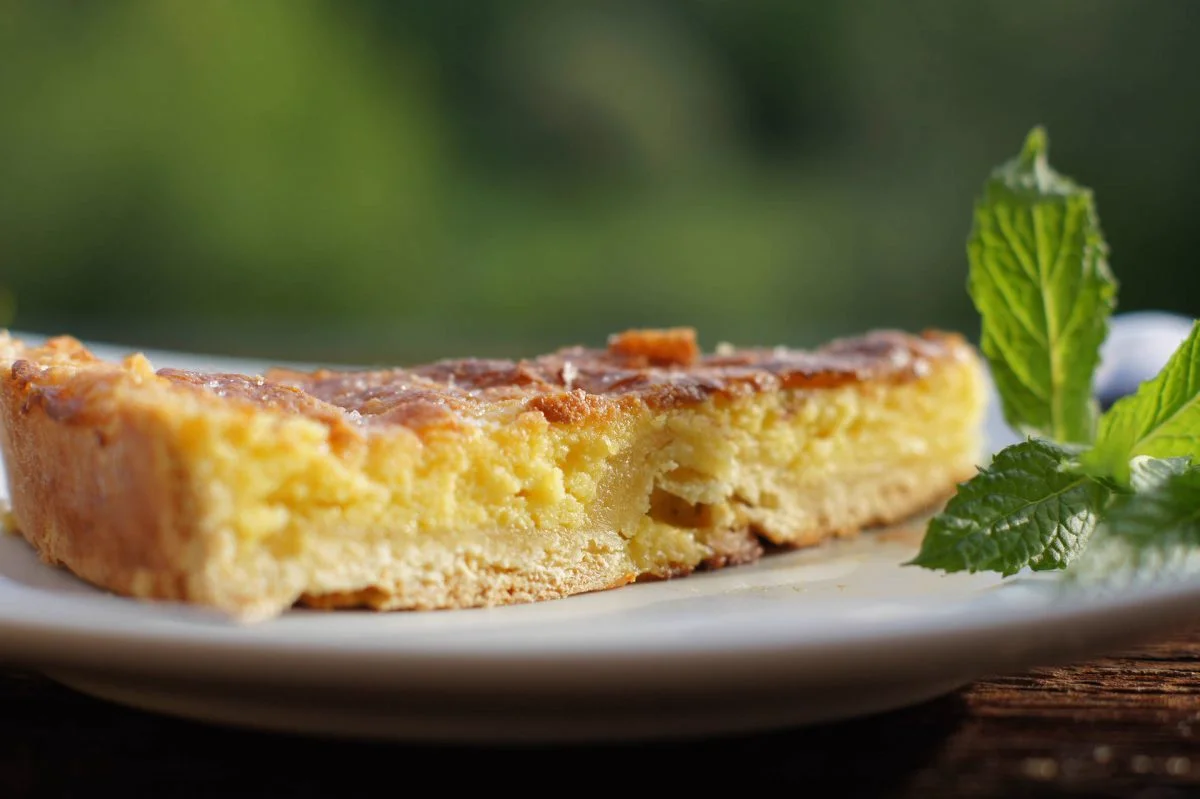
Two parts. A pastry made with eggs, flour, lard (or olive oil) and anisette, which gives it its characteristic aniseed note. And a filling of fresh sheep’s cheese, or a sheep and goat mix, with eggs, sugar and the signature ingredient: peppermint leaves, hierbabuena.
What strikes you when you taste it is the freshness the mint brings to the cheese. No other European cheesecake uses mint as its main flavouring, which is what makes flaó hard to compare. It is eaten cold, straight from the fridge, and it is better the next day.

The flaó recipe
There is no single recipe. This one is the most common version on the island, for a 24 cm tin and 8 slices.
For the pastry
- 250 g plain flour
- 2 eggs
- 125 g sugar
- 1 tablespoon lard (or olive oil)
- 1 tablespoon anisette
- The zest of half a lemon
- 1 teaspoon baking powder
For the filling
- 250 g fresh goat’s cheese
- 250 g fresh sheep’s cheese (or well-drained quark)
- 3 eggs
- 200 g sugar
- About ten fresh mint leaves (hierbabuena), plus a few to decorate
The steps
- Make the pastry. Sift the flour with the baking powder. Beat the sugar and eggs until the sugar dissolves, add the anisette, lemon zest and lard. Gradually work in the flour, knead, shape into a ball and leave to rest for 30 minutes.
- Make the filling. Cut the cheeses into pieces. Beat the eggs with the sugar, add the cheeses and blend until smooth.
- Add the finely chopped mint to the filling. The mint is what makes a flaó: do not swap it for dried mint, the flavour is nothing like it.
- Line the oiled tin with the rolled-out pastry, bringing it slightly up the sides.
- Fill and decorate with a few whole mint leaves placed on top.
- Bake at 180°C for 30 minutes for a thin flaó, up to 50 minutes for a thick one. The top should be golden and the centre set.
- Leave to cool in the tin, then chill. Dust with icing sugar before serving.
Recognition in progress
Flaó carries a guarantee mark (“Flaó d’Eivissa”) held by the island’s association of bakers and pastry makers, which sets rules for the recipe and the origin of the ingredients. The trade is aiming for a Protected Geographical Indication (PGI), the official European scheme, but it has not been granted yet. Around ten businesses back the application.
The distinction matters when you read that flaó is “PDO” or “protected”: the guarantee mark is a private trade initiative, not a European designation. That takes nothing away from the product, it is simply a different status. Flaó remains a shared heritage of Ibiza and Formentera, where it is made the same way.


Where to try flaó in Ibiza
You will find it almost everywhere, but quality varies a lot between an industrial supermarket flaó and an artisan version. A few well-known bakeries on the island:
- Forn Can Bufí, in Santa Eulària. A family bakery and patisserie, also known for its takeaway dishes.
- Forn Can Coves, one of the island’s pioneering bakeries, open since the mid-1970s. It works with several cheeses and also makes greixonera.
- Forn Can Vadell, in Ibiza Town (calle Canarias, between avenida de España and calle Aragón). Founded in 1923, run by the fourth generation of pastry makers.
- Can Rei, in Ibiza Town, regularly named among the best places in town for flaó.
Two useful tips on the ground. Buy it from a village bakery rather than a supermarket: the difference in texture is clear. And check opening hours before you go, as many of these bakeries close in the afternoon and on Sundays out of season.
The time of year when you find the most is still Easter, when families bring out their recipes. But flaó is eaten all year round, and the food markets are a good place to buy it by the slice.
Frequently asked questions
What is the difference between flaó and a cheesecake?
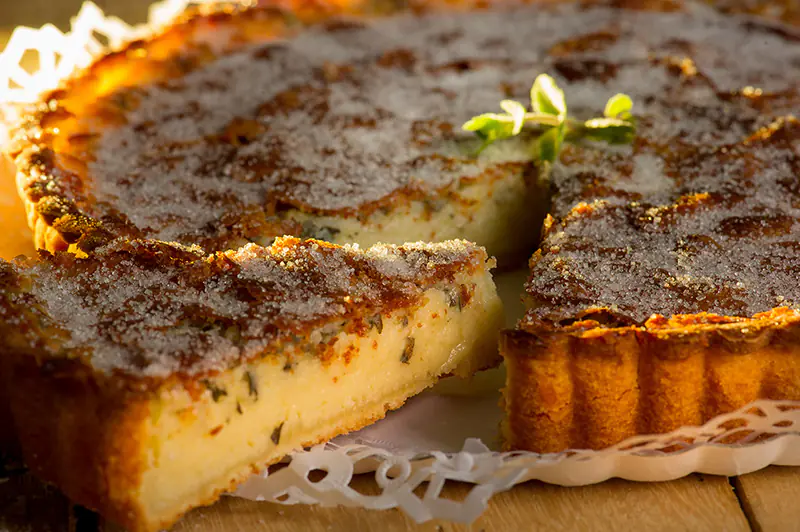
Three things. Flaó has a real pastry base baked in the tin, not a crushed biscuit base. It uses fresh sheep’s or goat’s cheese, not cream cheese. And above all, it is flavoured with mint and anise, where cheesecake sticks to vanilla or lemon.
Can you replace the sheep’s cheese?
Yes, with ricotta or well-drained quark. The texture will be softer and the flavour milder. The key is to use a fresh cheese that is low in salt and not too wet, otherwise the filling will not set in the oven.
Can you freeze flaó?
Best avoided. Like any mixture of fresh cheese and eggs, it releases water when thawed and the filling turns grainy. It does keep three to four days in the fridge, covered with cling film.
Flaó from Ibiza or Formentera?
It is the same dessert. Both islands claim it and make it the same way, while the official name of the guarantee mark refers to Eivissa. You will find it in bakeries on both islands.
Want to carry on exploring Ibizan desserts? Greixonera, the pudding made with stale ensaïmadas, and orelletes, the fritters of the village festivals, complete the trio. For Formentera, see the 10 must-try products of the local cuisine. To discover more Ibiza food specialities, start here.


