

In short
Ibiza and Formentera get a torrential rain episode almost every autumn, usually between mid-September and late October. The latest, Storm Adam (17-20 October 2026), dropped 195 l/m² in 24 hours on Formentera and 122 l/m² on Ibiza airport. These episodes last one to three days: the airport road and a few neighbourhoods flood, flights are cancelled or diverted, then the sun comes back. If you travel in autumn, leave a day’s margin before a connecting flight.
Latest episode (updated 23 October 2026)
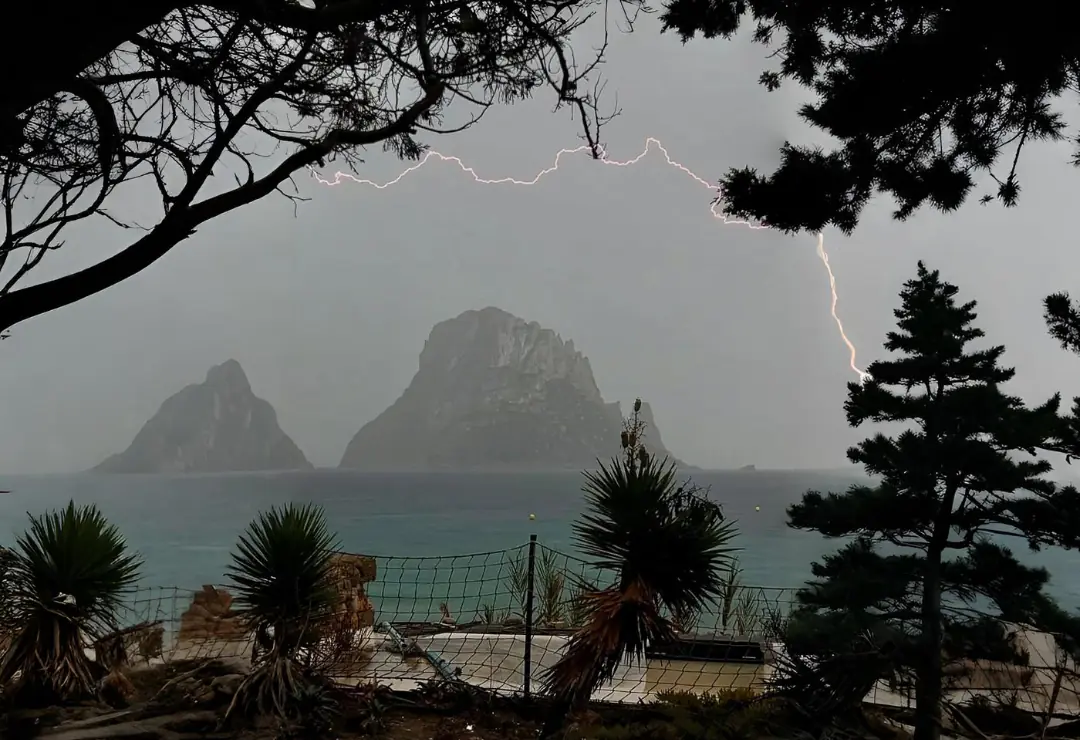
Storm Adam, 17 to 20 October 2026. On Sunday 18th, Aemet, the Spanish weather agency, put Ibiza and Formentera on red alert and an ES-Alert warning went out to every phone. Most of the rain fell that morning.
| Aemet station | Rain in 24 hours |
|---|---|
| Formentera, Sant Francesc | 195 l/m² |
| Ibiza airport | 122 l/m² |
| Sant Joan de Labritja | 97 l/m² |
| Eivissa (town) | 68 l/m² |
| Sant Antoni | 59 l/m² |
The airport was at a standstill for about two hours on the Sunday. Aena counted 5 flights cancelled and 16 diverted that day, then 5 cancellations on the Monday. The airport road stayed closed between km 3 and 5.5 (Platja d’en Bossa) until the Monday. The north of Santa Eulària and Sant Joan were hit hardest. No serious injuries were reported and the weather warnings were lifted on the morning of Tuesday 20th. According to the Balearic government, October 2026 is the wettest October in 75 years in Ibiza and Formentera.
Why it nearly always happens in autumn
Spaniards call it a DANA, what forecasters in English call a cut-off low: a pocket of cold air that breaks away high up and gets stuck over the Mediterranean. In September and October the sea is still warm from the summer. Cold air above and warm water below build storms that sit in the same place for hours instead of moving on.
The result is figures you never see the rest of the year. On 30 September 2025, the Eivissa station collected 253 l/m² in a single day, a record. The average for the whole of September is 61. The airport recorded 176 l/m², its highest since records began in 1952. That month, the island got two and a half times its normal rainfall (Aemet climate summary for September 2025, in Spanish).
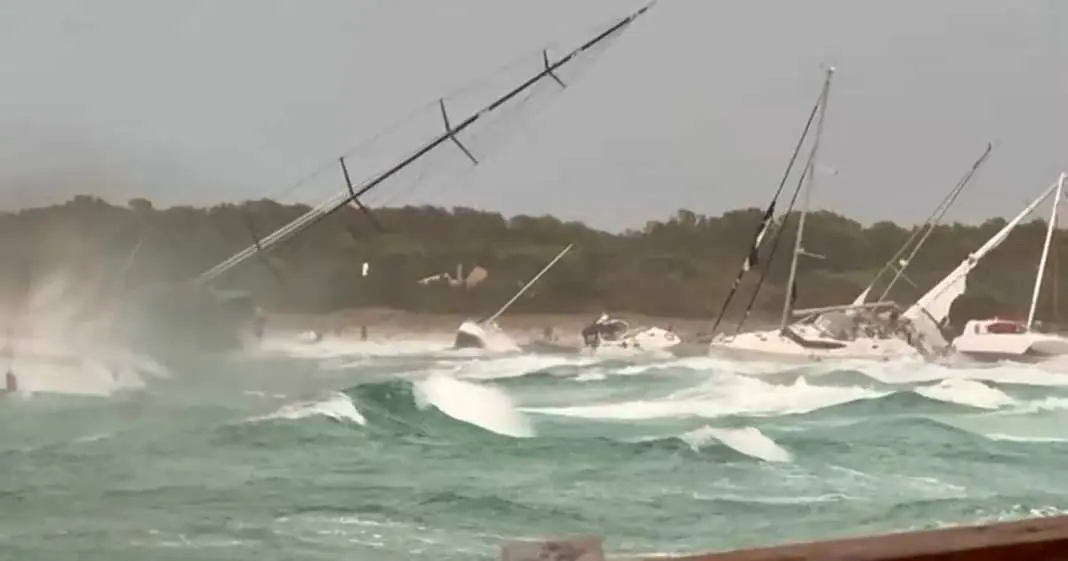
Summer is not completely safe either. On 14 August 2024, after several days of heatwave, an unusually violent storm hit Formentera, with gusts estimated at 100 to 120 km/h. I had been on the island the day before. The port closed and a dozen boats were thrown onto the rocks. That kind of summer storm remains the exception. The rain episodes that flood the roads come in autumn, three years running since 2024.
Four episodes in two years
| Date | Episode | What happened | Remembered for |
|---|---|---|---|
| 14 August 2024 | Summer storm on Formentera | Gusts estimated at 100 to 120 km/h, La Savina port closed, a dozen boats thrown onto the rocks. An 89 km/h gust at Ibiza airport, its strongest since 1965. | Boats wrecked at La Savina |
| 30 September 2025 | Ex-hurricane Gabrielle | Red alert, 253 l/m² in Eivissa (record). Airport road under 3 million litres of water, Es Pratet and Avenida Isidor Macabich flooded. | The wettest day on record in Eivissa |
| 10-12 October 2025 | Storm Alice | Orange alert. Airport closed from 6pm to 7.20pm on 11 October, 24 flights cancelled. Airport road and Jesús roundabout closed, over 100 l/m² in Sant Antoni. | An airport closure on a Saturday evening |
| 17-20 October 2026 | Storm Adam | Red alert and ES-Alert. 195 l/m² on Formentera, 122 l/m² at the airport, 5 flights cancelled and 16 diverted on 18 October. Wettest October in 75 years. | See “Latest episode” above |
The pattern repeats each time. The warning comes the day before or that morning. The rain is concentrated over a few hours, then the town spends a day or two pumping and cleaning up. Nobody died in Ibiza or Formentera in any of these four episodes. The damage is material: ground floors, garages, shops, cars.
The places that flood every time
The airport road is the island’s black spot. Near Sant Jordi, by the racecourse and under the ses Salines roundabout, it runs through a cutting below ground level. Water runs down into it and has nowhere to go. After Gabrielle, it took three high-capacity pumps, brought in by the army from Zaragoza and Madrid, to drain that stretch. The mayor of Sant Josep said it had been unusable for three days. During Adam it was closed again between km 3 and 5.5.

In Ibiza town, it is the low-lying districts: Es Pratet, Avenida Isidor Macabich, Carrer de Madrid. The drains overflow and the streets turn into ponds for a few hours.
Platja d’en Bossa floods every time too, from Carrer Murtra to the Gamba Roja roundabout. That is where many of the hotels are, a stone’s throw from the airport road.
Sant Antoni gets high totals: more than 100 l/m² during Alice. The underpasses at Can Fonoll and the roads towards the salt flats fill up fast.
The north of the island, Santa Eulària and Sant Joan, was hit hardest during Adam. The streams, dry all summer, rise there in a few hours.
On Formentera, the sea is as much of a problem as the rain. When the harbour authority closes La Savina port, the island is cut off from Ibiza, as in August 2024.
Airport and ferries during a warning
Ibiza airport rarely closes for long. Suspensions last one to two hours, while the storm passes: 1 hour 20 during Alice, about two hours during Adam. In the meantime, incoming planes are diverted to another airport, and the airline then gets you to Ibiza.
The real risk is the road. In September 2025, travellers missed their flights because they could no longer reach the terminal, even though the runways were working. On an orange or red alert day, leave for the airport much earlier than usual. If the road is closed, call your airline before boarding time: once the flight has gone, you are treated as a no-show.
Ferries between Ibiza and Formentera can be suspended when the sea is too rough. Check your ferry company’s website that morning, and leave a margin if your flight home leaves Ibiza on the day you leave Formentera. Our Ibiza to Formentera ferry guide covers the companies and timetables.
Following the warnings
Aemet publishes its weather warnings by area, in yellow, orange or red. Ibiza and Formentera are grouped together as “Ibiza y Formentera”. Orange means significant danger, red extraordinary danger. The last two major episodes were red.
ES-Alert arrives on its own: a message pops up on every phone connected to a Spanish network, UK phones on roaming included, with a loud alarm. The message is in Spanish and Catalan. It usually asks you to limit travel and keep away from streams and flood-prone areas.
In an emergency, call 112.
The basic rules: never drive through a flooded street, even if the water looks shallow. Avoid underground car parks and underpasses, and do not stop near a stream.
Flight cancelled because of the storm: your rights
European air passenger rights apply to every flight departing from Ibiza, including flights to the UK. There are two separate things.
Compensation (€250 for a flight under 1,500 km such as Ibiza-London, €400 beyond) is not owed. Weather counts as one of the “extraordinary circumstances” that exempt airlines.
Assistance is still owed, whatever the cause. The airline must offer you the choice between a refund and rerouting, then cover meals while you wait, a hotel if you have to leave the next day and transport to the hotel. If it does not and you pay yourself, keep every receipt: it must refund reasonable expenses.
My view: September yes, October for other reasons
For me, September is the ideal month. The sea has had all summer to warm up, the beaches empty and prices come down. An episode like Gabrielle costs you one or two days out of a week, rarely more.
In October it starts to get cooler. I have been and I swam, but the weather is not at its kindest. It is, on the other hand, a very good month for diving in Ibiza, and for all the activities the island offers away from the beach.
Either way, I would take three precautions. Accommodation that is not on the ground floor in Platja d’en Bossa or the low-lying parts of Ibiza town. No flight home with a tight connection. And an eye on the Aemet warnings three days before you leave, when cut-off low forecasts become reliable. To pick the best time for what you want to do, our guide on when to go to Ibiza and Formentera compares the months one by one.
This rain does not solve the islands’ water problem. Despite a record October, the Alianza por el Agua explains that the water runs off to the sea too fast to recharge the aquifers, and Ibiza remains on drought pre-alert.
Frequently asked questions
Is there flooding in Ibiza right now?
The “Latest episode” section at the top of this page shows when it was last updated. As of 23 October 2026, the weather warnings linked to Storm Adam have been lifted since 20 October. For the real-time situation, check the Aemet warnings for the “Ibiza y Formentera” area.
When does flooding happen in Ibiza?
Mostly from mid-September to late October, when a cut-off low settles over a sea that is still warm. The four notable episodes since 2024 fell on 14 August, 30 September, 10 to 12 October and 17 to 20 October.
Should I cancel a trip to Ibiza in October?
No. An episode lasts one to three days and life is back to normal the next day. October is cooler than September: you can still swim, but it is above all a good month for diving and activities. Avoid tight connections on the way home and check the Aemet warnings three days before you leave.
Does Ibiza airport close during storms?
Usually for one to two hours: 1 hour 20 during Storm Alice in 2025, about two hours during Storm Adam in 2026. Planes are diverted and then brought in. The main risk is the access road, closed in each of the last three rain episodes.
Am I entitled to compensation if my flight is cancelled because of the weather?
Not to the fixed compensation (€250 and up), because weather is an extraordinary circumstance. The airline must however offer you a refund or rerouting, and cover meals and a hotel while you wait.
What is a DANA?
It is the Spanish name for what English forecasters call a cut-off low: a pocket of cold air isolated high up, which gets stuck over the Mediterranean and triggers storms that do not move. It can drop more rain in a few hours than usually falls in a month.


