
Ibiza has some twenty dive sites within easy reach. Around fifteen walls, a dozen reefs and a few wrecks to suit every taste. Yes, in Ibiza there are dives for everyone!
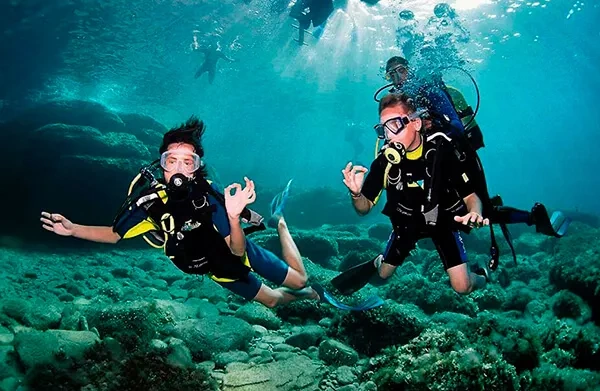
From rocky pinnacles rising from the depths to wrecks steeped in history and coral gardens full of colourful life… There is plenty of choice! Here is the list of the island’s best spots!
Where to dive Ibiza’s best wrecks?
Balearic wrecks attract scuba divers and freedivers. They concentrate dense marine life and many stories to discover.
Check your level before you go.
Always dive with a certified local centre. Each site requires a minimum of experience. An instructor knows the currents, the day’s visibility and the specific risks, and adapts the dive to your profile. It is non-negotiable for your safety…
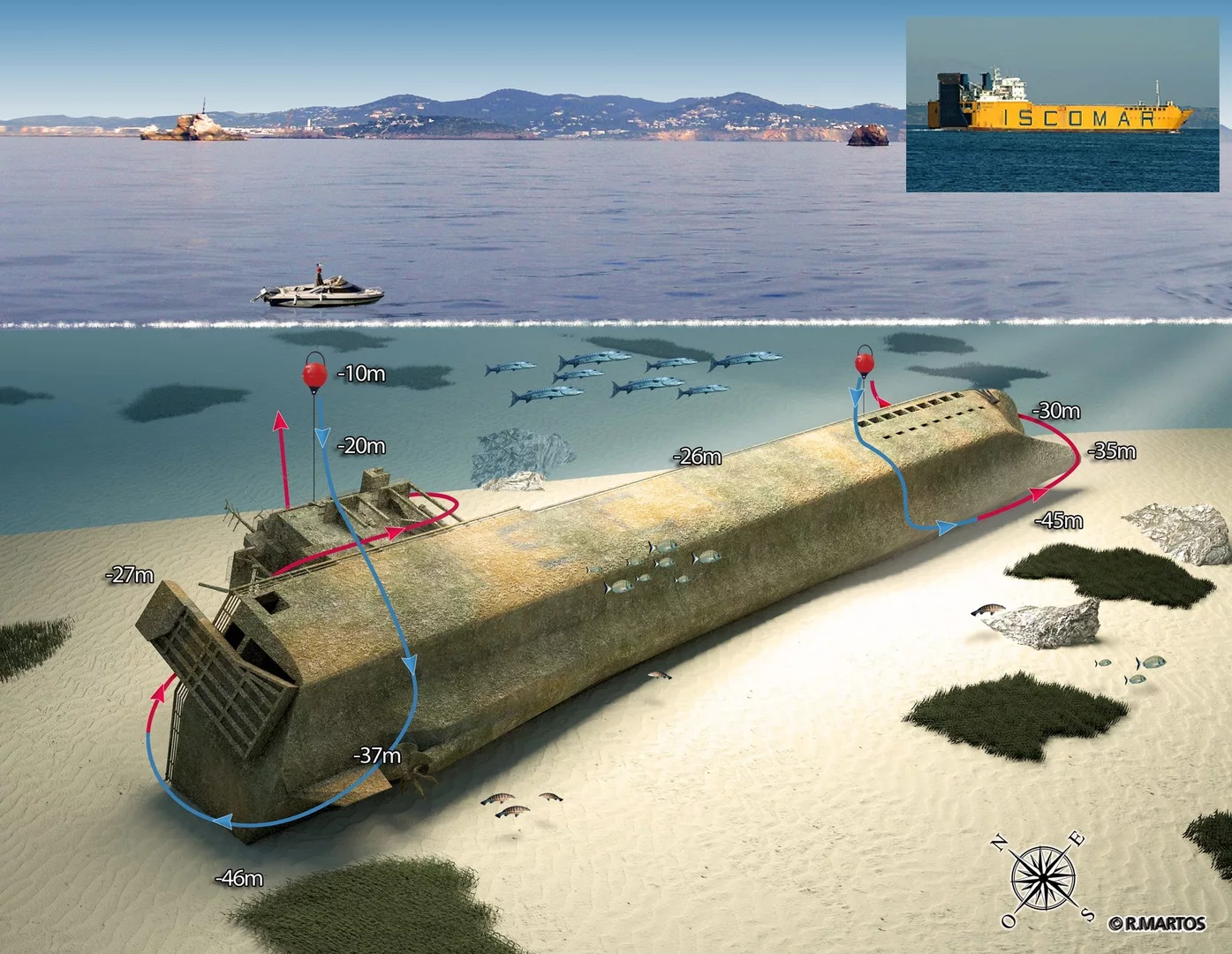
The Don Pedro wreck
Location: 38.87333, 1.7208 (Google Maps)
The largest wreck in the Mediterranean, for experienced divers only (depth 26 to 46 metres).
An exceptional wreck
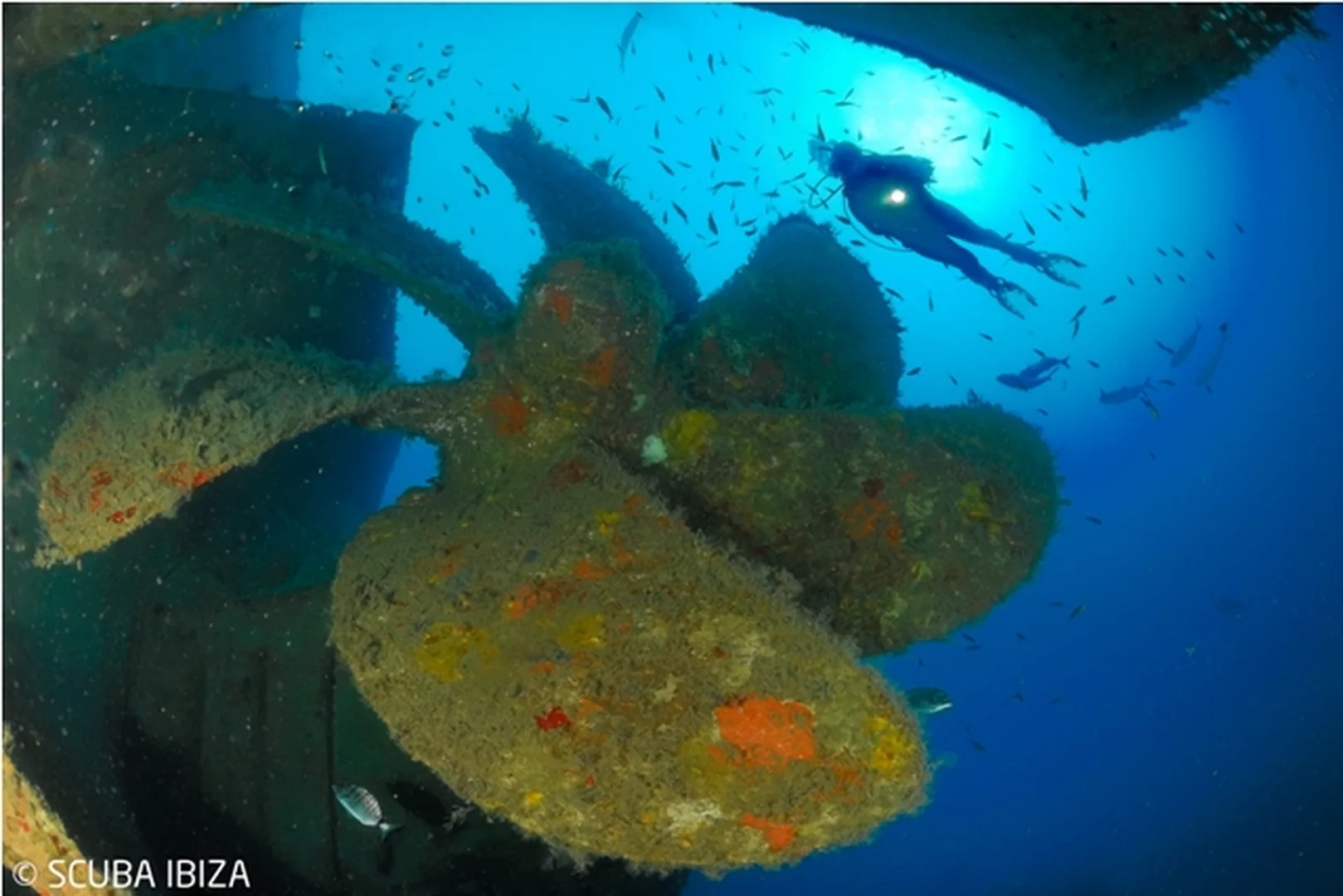
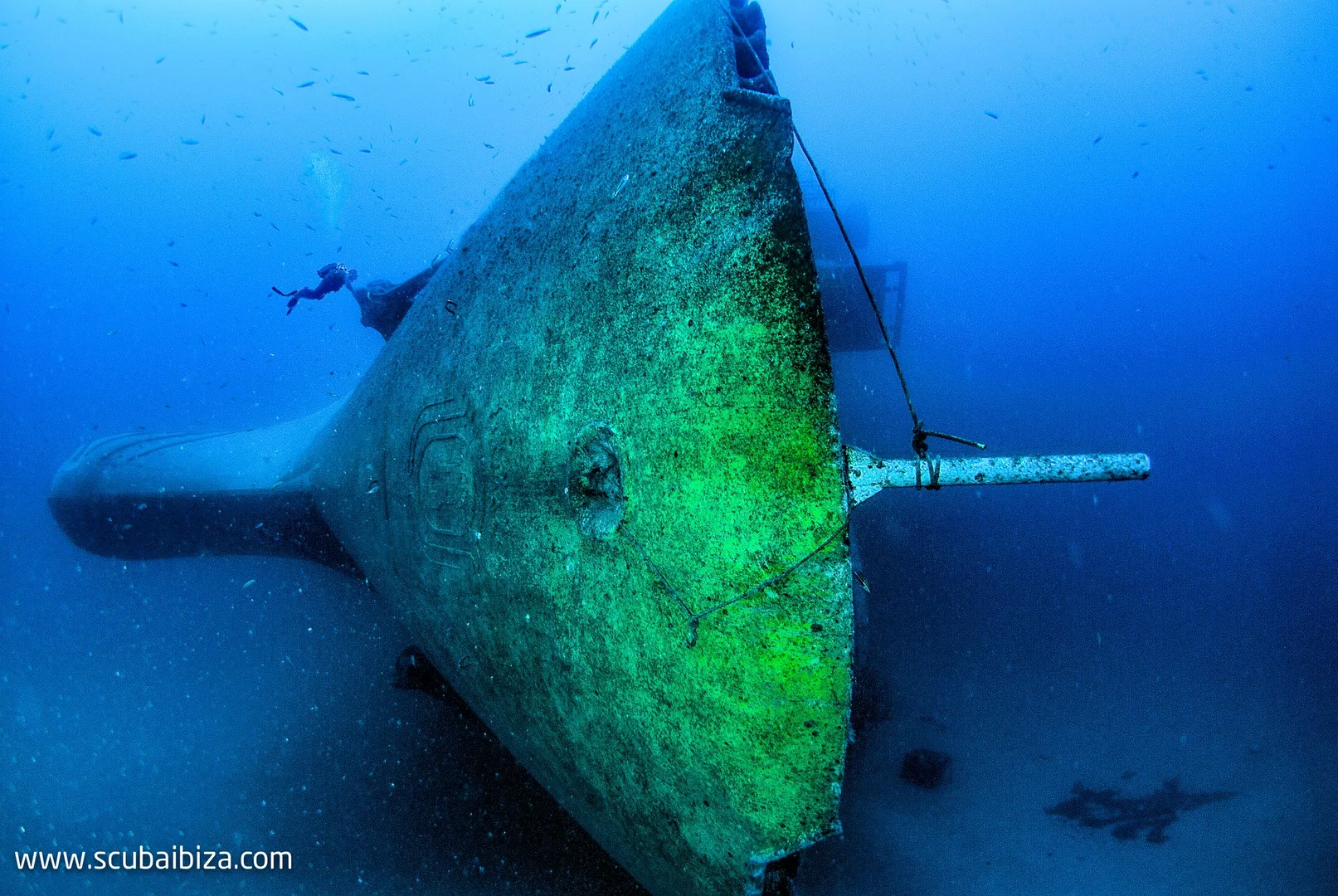
Nearly 150 metres of ship. The Don Pedro is probably the largest wreck accessible to recreational divers in the Mediterranean. It sank to 40 metres after hitting the Dado Pequeño islet, and offers an exploration like no other.
Experience required
This site is not for everyone. Some areas, or even all of it, require more than basic certification. Deep, wreck, cave or technical diving: extra training may be needed.
Usual marine life: barracuda, jack, moray eel, lobster
The “Plataforma Mariana” wreck
Location: 38.78811, 1.47388 (Google Maps)
- Dive type: Wreck, Reef
- Usual marine life: scorpionfish, jack, grouper, pelagic fish, eels, lobster, reef fish
- Maximum depth: 33 metres
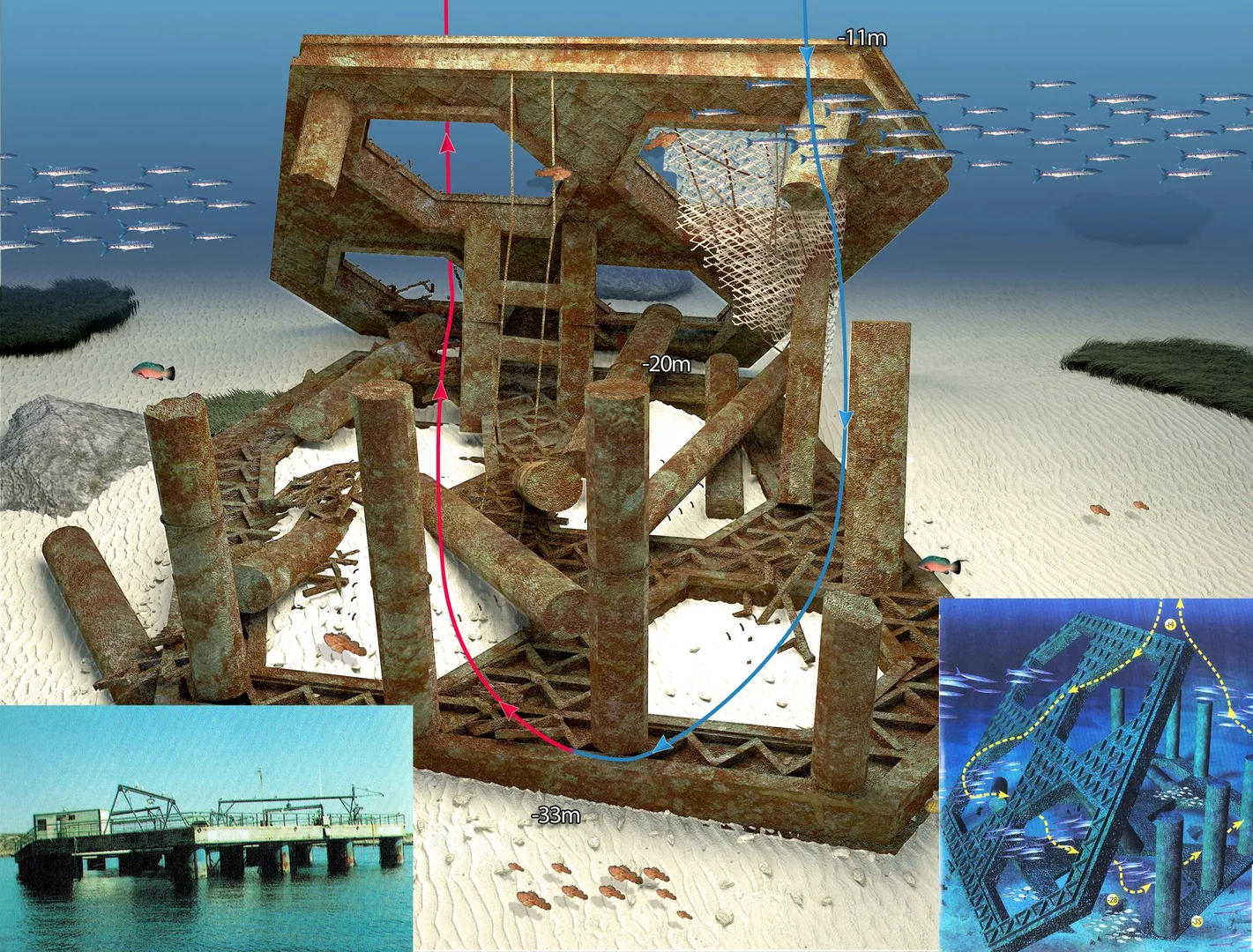
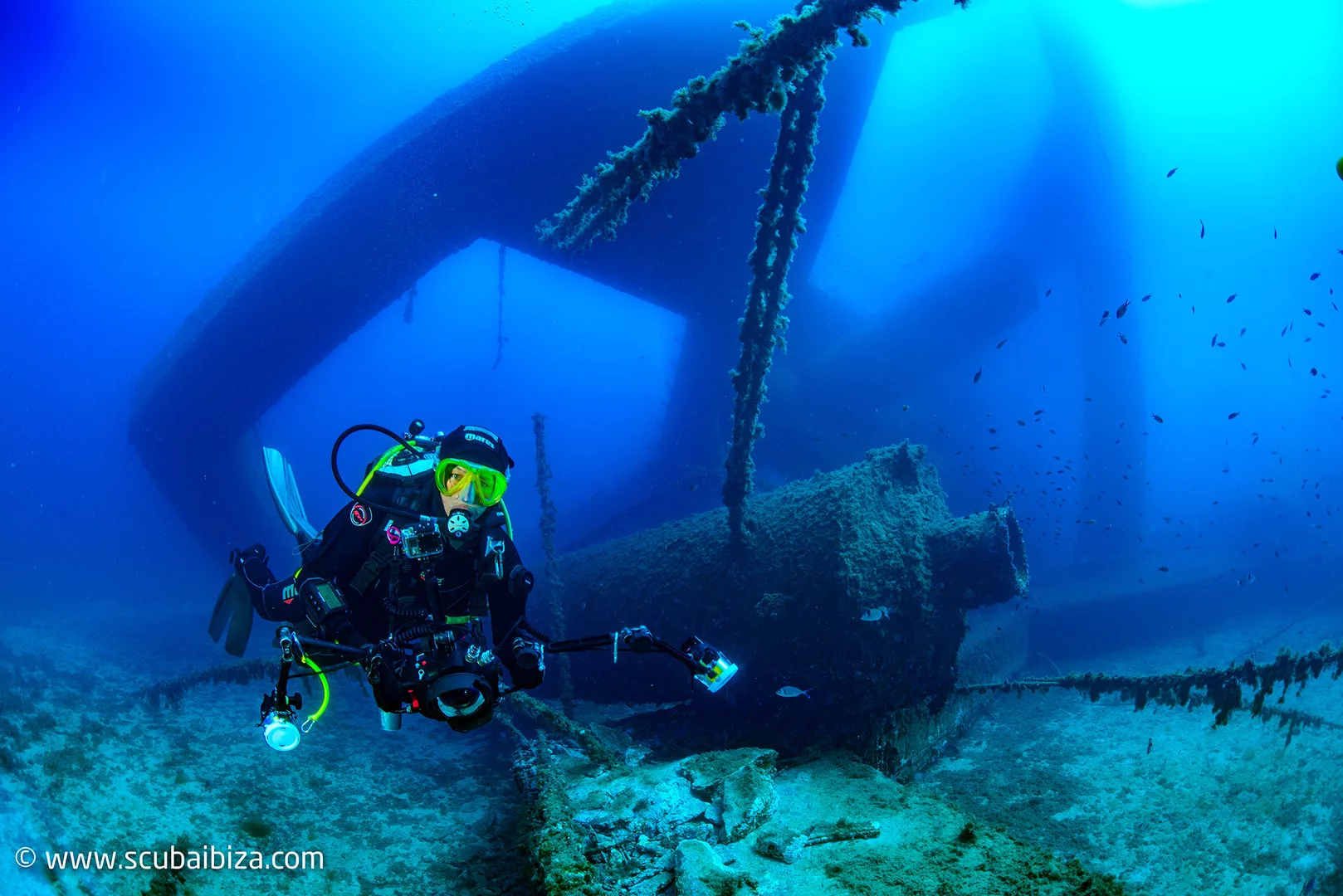
30 minutes by boat from Ibiza, in the marine reserve, lies the wreck of a former fish farm. La Plataforma looks like an oil rig. Some divers swear it is like floating in a spaceship.
You will be surrounded by hundreds of barracuda in formation. Amberjack, grouper, conger eels, moray eels and scorpionfish also live here, with crustaceans galore. The water ranges from 14 to 28 °C, comfortable all year round.
Advanced or Deep Diver certification is required. You descend to 33 metres and come back up gradually in a spiral. Average visibility is 30 metres. Enriched Air Diver training is recommended to explore with peace of mind. Ideal for photos and video.
The Lighthouse | El Faro
Location: 38.96718, 1.61559 (Google Maps)
- Dive type: Wreck, Wall, Open ocean
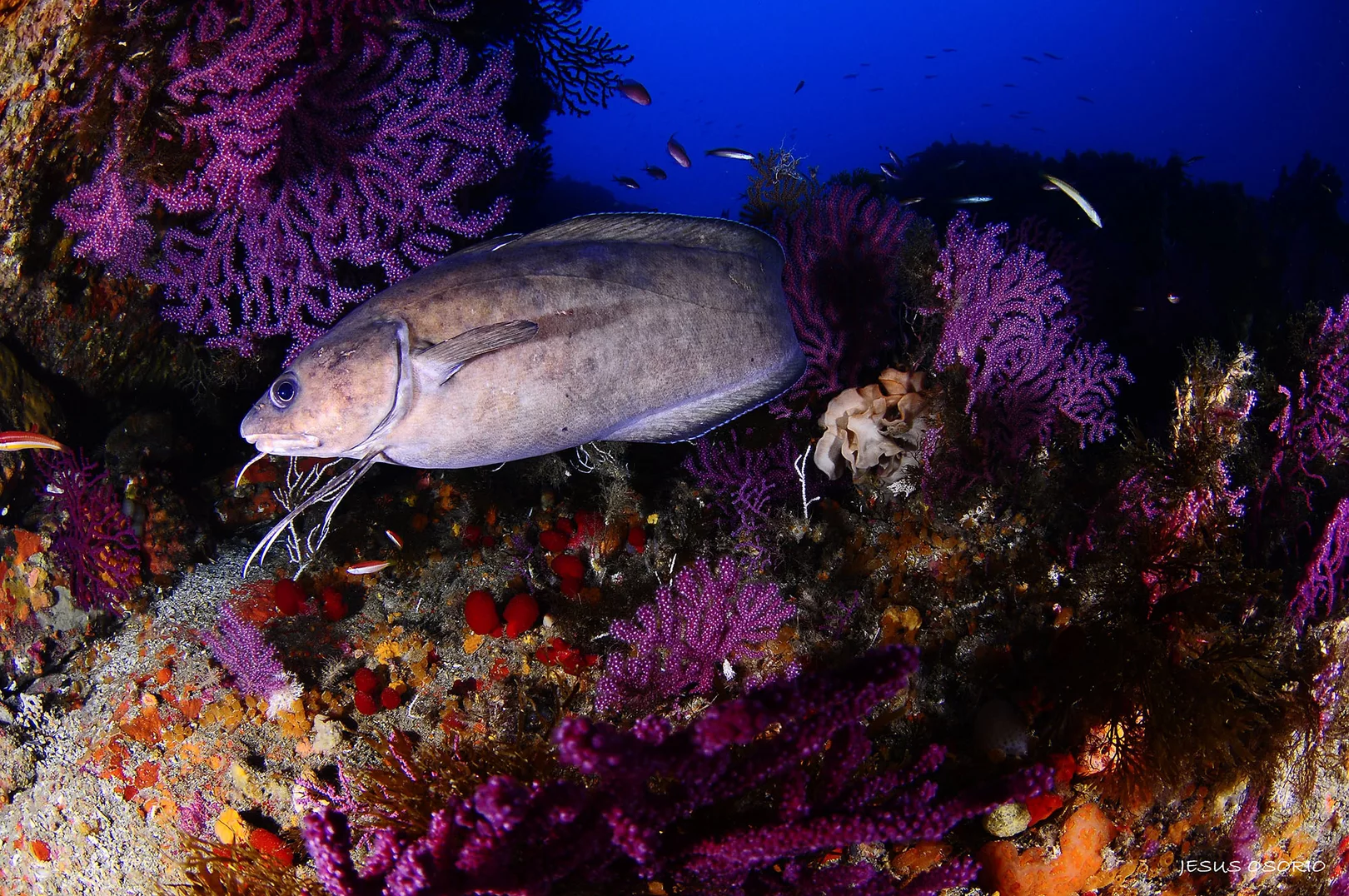
- Usual marine life: barracuda, moray eel, octopus, nudibranch
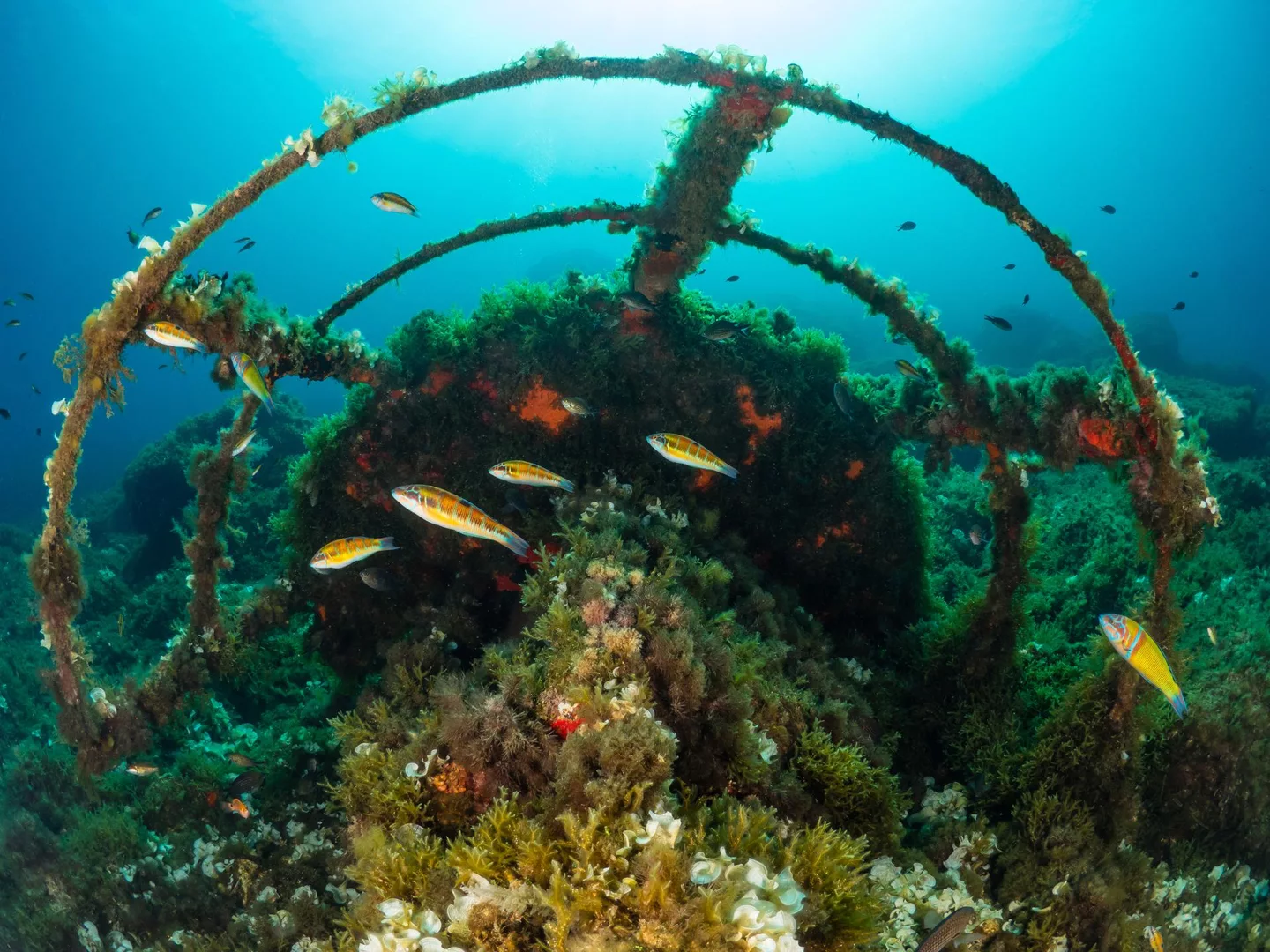
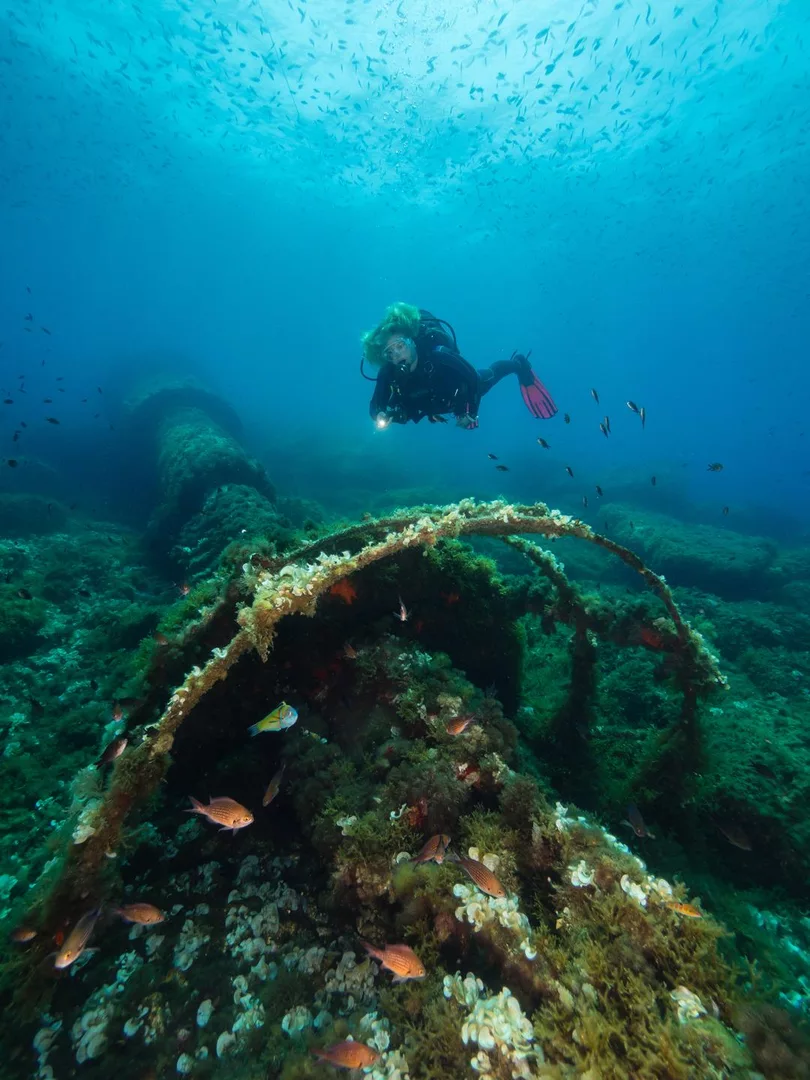
On the Santa Eulalia reef, a few minutes by boat from Cala Martina, The Lighthouse is one of Ibiza’s most iconic sites. Despite the name, it is not a monumental lighthouse but a navigation beacon that ended up on the reef.
What makes this spot unique is its stepped layout. The “lighthouse” lies between 2 and 12 metres deep, while the reef walls drop to 26 metres. It is an ideal site for underwater photography thanks to the clear water and the concentration of life.
- Highlights: since 2018 the area has been a marine reserve, guaranteeing a permanent show: shoals of silver barracuda, moray eels hiding in the rocks and curious octopus.
- Who is it for? Very accessible, it is perfect for a try dive or a refresher dive, while offering deeper routes for Advanced Open Water divers.
- Expert tip: keep your eyes open at the end of the dive near the beacon structure: colourful nudibranchs are often there!
Where to dive Ibiza’s best walls?
Ibiza offers exceptional diving, notably thanks to its unique Posidonia meadows and excellent visibility. Far from overexploited coasts, it is a real playground for divers, with visibility often over 30 metres. The water stays pleasant even late in the season, and the biodiversity, fish, crustaceans and cephalopods, makes it well worth the trip.
A wall is where the seabed drops suddenly from horizontal to vertical. It is the transition between the shallow shelf, where seagrass grows, and open water that gradually goes deeper. This break in relief concentrates particular biodiversity and creates distinctive diving conditions.
Divers love them. They combine a gradual, accessible structure (from 5 to more than 30 metres), rocky architecture full of ecological niches and diverse marine life (barracuda, grouper, octopus, pelagic species), without requiring the technical certification needed for wrecks.
Here are the best wall dives in Ibiza:
La Bota
- Location: 38.87593, 1.19039 (Google Maps)
- Dive type: Wall
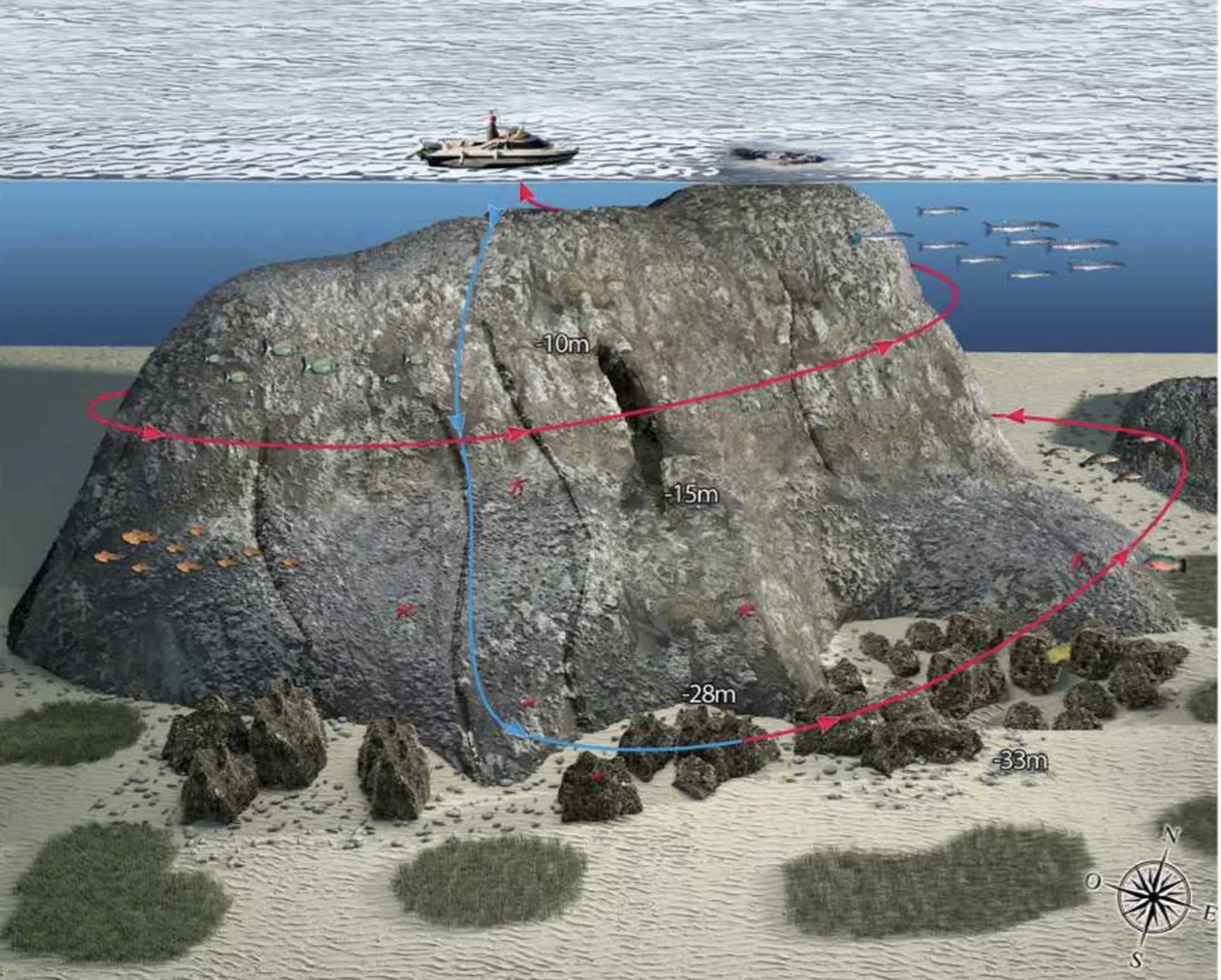
La Bota is an underwater pinnacle 1 mile north-west of Es Vedrà. It rises from more than 50 metres deep to a few centimetres below the surface. The swirling waves are your only marker!
Far from the coast, the site attracts big migratory fish: tuna, amberjack and shoals of barracuda pass by regularly. You are sure to see barracuda.
La Aguja de Bestorre
- Location: 38.86503, 1.18999 (Google Maps)
- Dive type: Cave, Wall
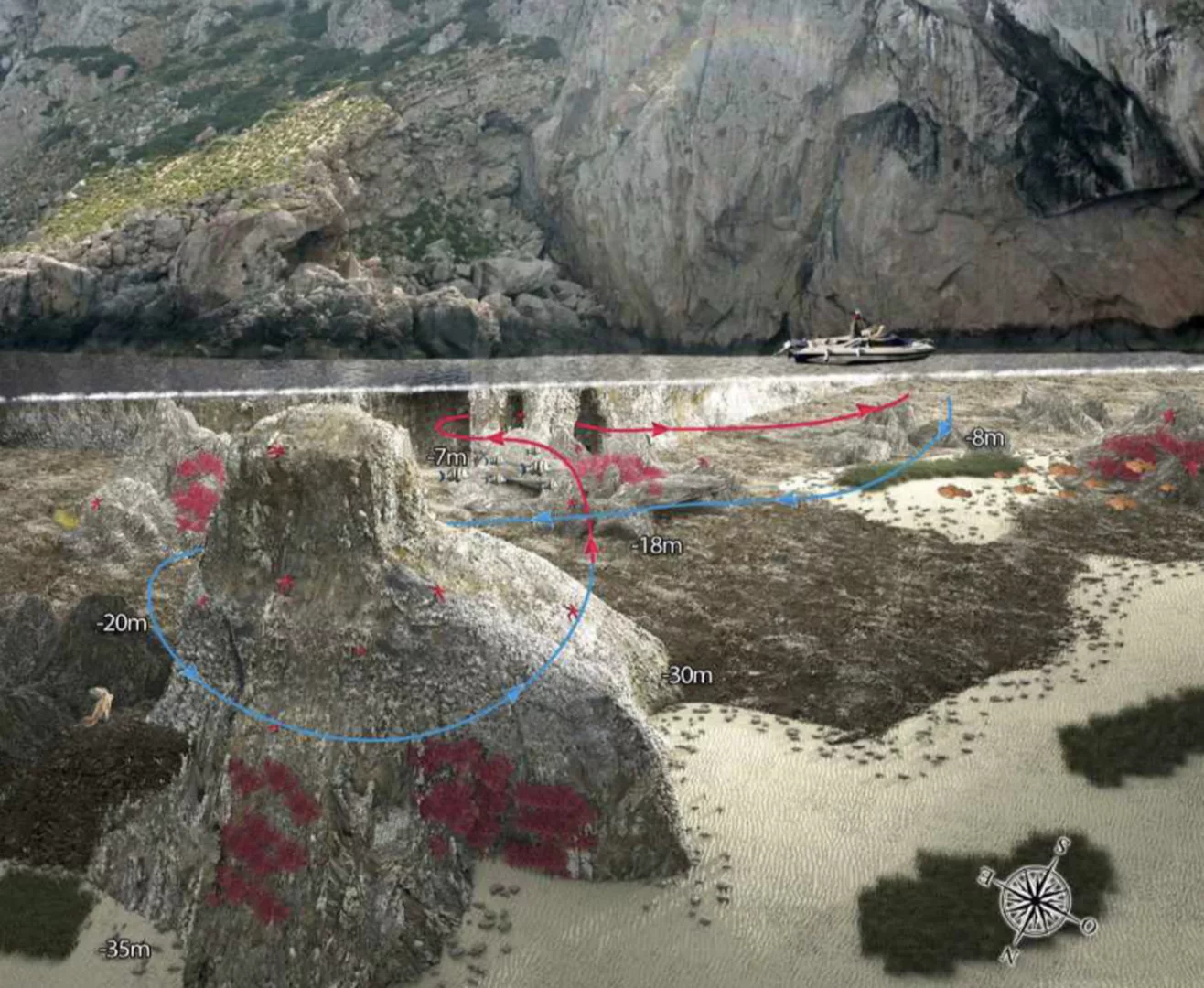
The Aguja is an underwater pinnacle near Es Vedrà, on the south-west side. It rises from 40 metres to just 3 metres below the surface.
On the way down, you follow the north wall of the island. Large boulders form arches and secret passages.
Lobster, grouper, ornate wrasse and scorpionfish live on the site.
Cañones de Vedranell
- Location: 38.86831, 1.20672 (Google Maps)
- Dive type: Wall, Channel
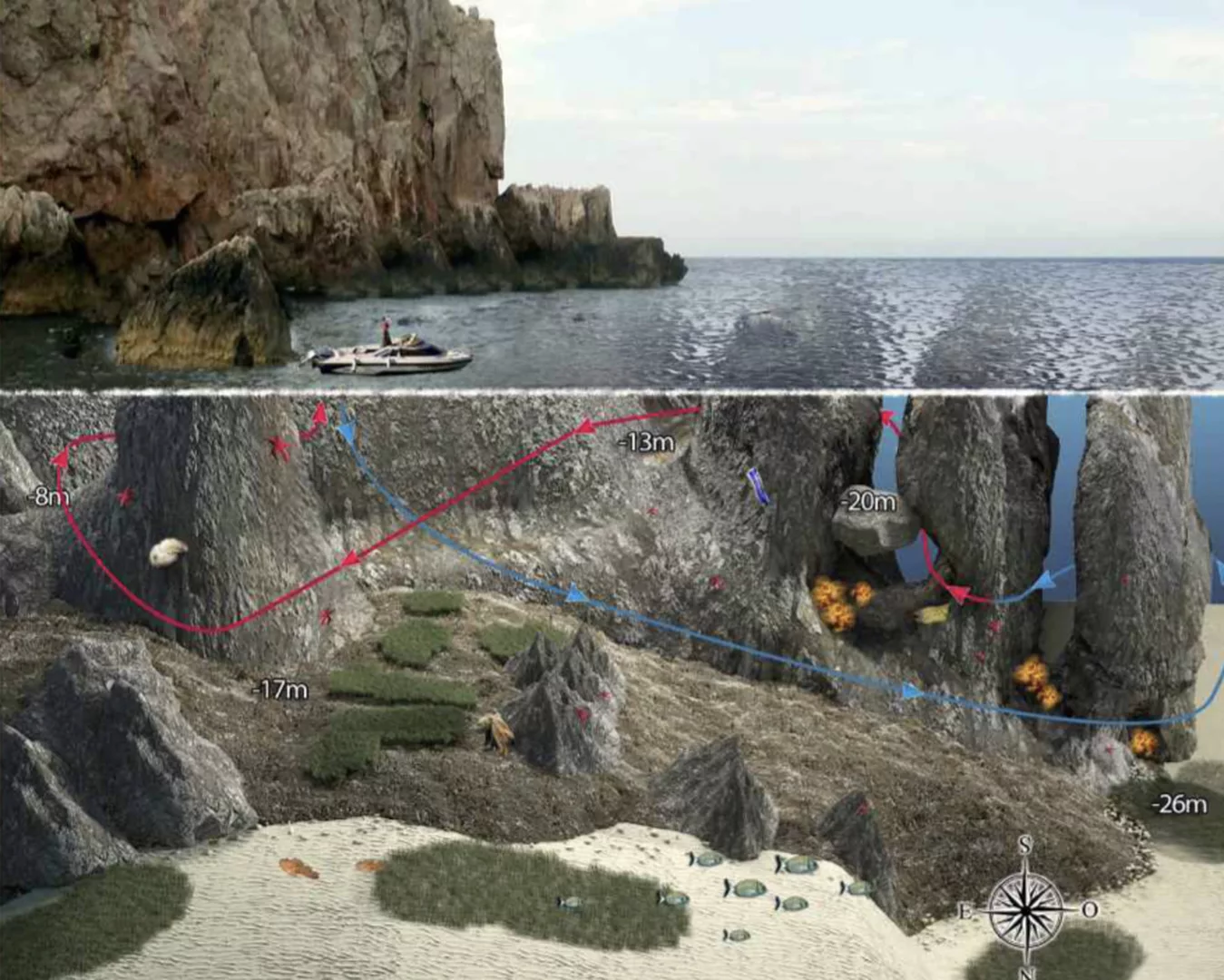
Es Vedranell (next to Es Vedrà) fascinates divers. Its winding canyons offer a unique geological exploration. The rock walls drop sharply, creating relief and a sense of intimacy.
The marine life is rich. Yellow anemones, fragile bryozoans and colourful nudibranchs fill every corner. The narrow passages give a real sense of adventure.
In practice, this is the dive that breaks the routine: no flat reef, but a real structure to explore.
Escalón de Espartà
Location: 38.95668, 1.19926
- Dive type: Wall
S’Espartar captivates divers for a simple reason: variety. In a single dive, you cross several underwater worlds.
You start in living Posidonia meadows. Then the terrain picks up. Massive rocks rise up, drop vertically and create relief. Gentle slopes turn into steep walls. This constant progression keeps you interested from start to finish.
The marine life follows the terrain: barracuda, grouper, octopus, moray eels, nudibranchs. Each zone attracts its own residents. You never do the same dive twice.
Las Gorgonias
Location: 38.96902, 1.16561
- Dive type: Wall
Las Gorgonias, at the Bledes islands, is a spectacular dive. After a narrow strait, you descend on the south-west side, where the anchor holds at 10 metres.
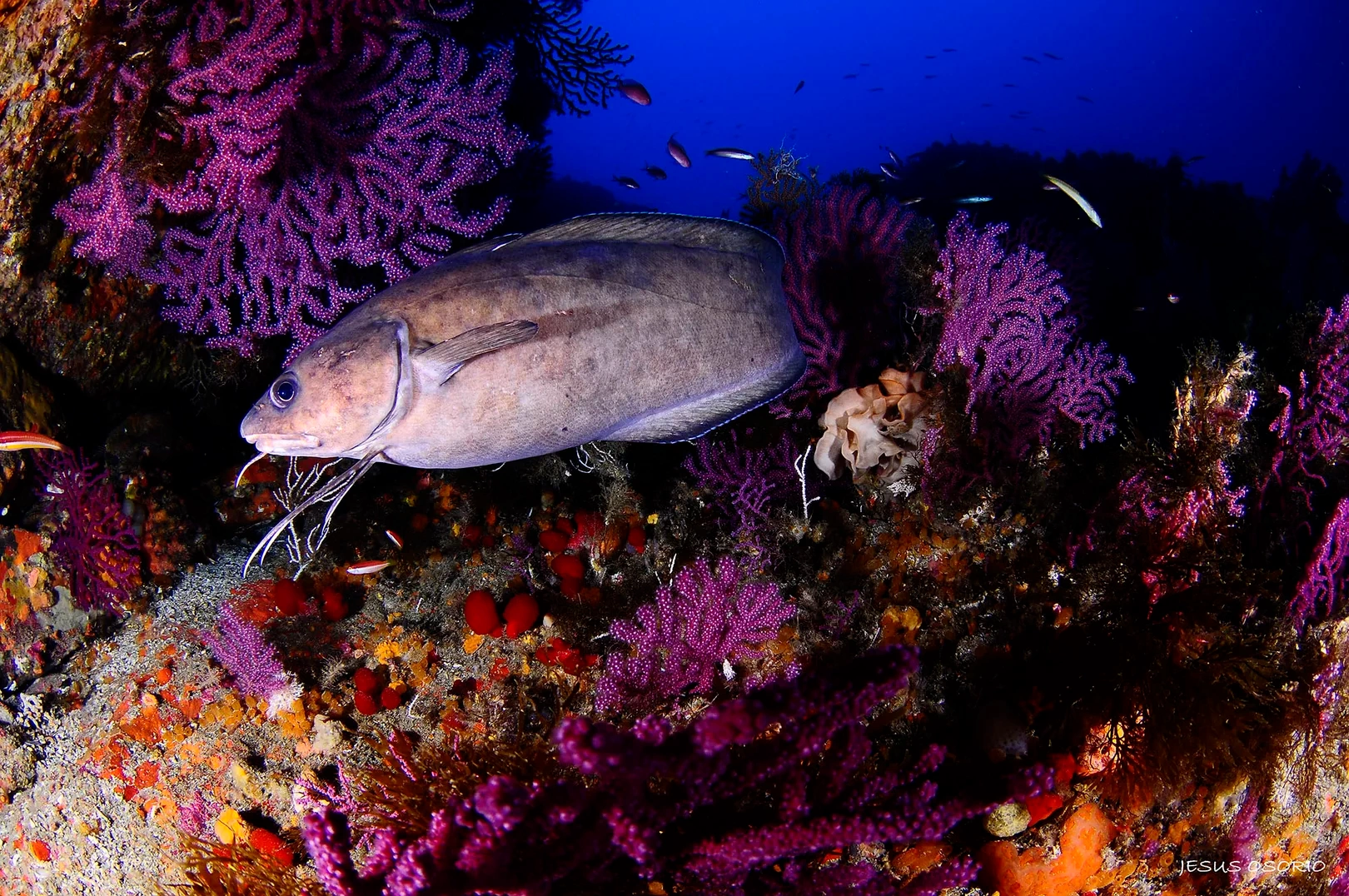
The terrain drops quickly. At 30 metres, gardens of bright red gorgonians appear: an entire wall carpeted with these delicate colonies and their coloured skeletons.
The appeal? Rare, fragile marine life. Gorgonians that few sites can offer. Explore with a torch to see their true red. A photogenic, memorable dive.
Lladó Sur
Location: 38.90226, 1.50169
- Dive type: Reef, Wall
An islet with three faces. An accessible platform at 12 to 15 metres to the north. A gradual wall to 20 metres to the west. A deeper drop to 30 to 37 metres to the south.
Everyone finds their level. Beginners, intermediate or experienced: the site adapts to you.
Where to dive Ibiza’s best reefs?
Faro
- Location: 38.94112, 1.55405
- Dive type: Reef
It is not a lighthouse, as the name suggests, but a beacon.
The site has 2 sectors. The first, perfect for beginners, offers a gradual slope between 2 and 10 metres with a spectacular rocky platform. Its cracks shelter varied marine life: octopus, moray eels and crustaceans. For experienced divers, going down along the platform to the sandy bottom gives access to a historic beacon lying at 12 metres, home to conger and moray eels.
Lladó Norte
Location: 38.91054, 1.50547
- Dive type: Reef
Rugged relief and mounds dotted with crevices. Every crack hides something: grouper, octopus, moray eels, barracuda, sea bream.
You are not exploring a flat seabed. You are hunting for secrets. Ideal for macro and photography.
Bajo de la Esponja
Location: 38.87553, 1.42994
- Dive type: Reef, Wall
Bajo de la Esponja is a huge rock 150 metres from the islet. It rises from 32 to 12 metres deep.
You dive in an upward spiral around the structure. Constant relief, natural progression, smooth exploration. A dive that almost draws itself.
Bajo del Lladó Norte
Location: 38.91141, 1.50328
- Dive type: Reef, Wall
- Usual marine life: grouper, barracuda, moray eel, crab, octopus, lobster, nudibranch
- Maximum depth: 28 metres
Piles of rocks sheltering secret life. Shine a light on the rocks and the bryozoans explode with colour!
Bajo de las Xelles
Location: 38.88554, 1.43653
- Dive type: Reef, Wall
- Usual marine life: barracuda, grouper, eels, moray eel, lobster, nudibranch
- Maximum depth: 23 metres
An arch with a sandy bottom and many holes full of varied marine life.
An accessible, instructive dive. Perfect for beginners.
Malvín Sur
Location: 38.88409, 1.43466
- Dive type: Reef, Wall
- Usual marine life: barracuda, grouper, seahorse, scorpionfish, moray eel, nudibranch
- Maximum depth: 27 metres
The best spot to explore the Posidonia, a Unesco World Heritage site. A simple but lively islet.
Accessible to all: beginners and experienced divers alike will enjoy it.
Malvín Norte
Location: 38.88867, 1.43803
- Dive type: Reef, Wall
A seabed covered with Posidonia oceanica, walls full of life, small caves and scattered archaeological remains.
Underwater history and biodiversity: a dive that tells several stories.
Xelles
Location: 38.88545, 1.43513
- Dive type: Reef, Wall
- Usual marine life: jack, tuna, barracuda, sunfish (mola mola), grouper, seahorse, pelagic fish, triggerfish, trumpetfish / pipefish, scorpionfish, electric ray, starfish, eels, sea cucumber, moray eel, shrimp, clam, lobster, giant cuttlefish, squid, octopus, crab, nudibranch, sea anemone
- Maximum depth: 24 metres
Rocks between 10 and 15 metres that slope gently down to 30 metres. A plaque in tribute to Jacques Cousteau lies here.
Grouper, forkbeard, moray eels, octopus and scorpionfish among the stones, on a Posidonia bed. History, relief and marine life combined.
Dado Pequeño
Location: 38.88215, 1.47783
- Dive type: Reef, Wall
- Usual marine life: barracuda, grouper, scorpionfish, moray eel, starfish, sea cucumber, crab, shrimp, lobster, squid, nudibranch, octopus, jellyfish
- Maximum depth: 30 metres
Los Dados: two small rocks and one of the best spots in Ibiza. Walls down to 30 metres carpeted with Mediterranean life.
In winter, a paradise for miniature nudibranchs. Compact relief, concentrated marine life, intense exploration.
Es Pallaret
Location: 38.97796, 1.23210
- Dive type: Reef
- Maximum depth: 30 metres
Near Sa Conillera island, off Sant Antoni.
Dive near Punta de Sa Torre heading south-west. About 12 metres deep at the start. The rocky bottom then drops away steeply and the islet’s walls take over. Gradual relief.
Where to dive Ibiza’s best pinnacles?
Esponja
Location: 38.87513, 1.42608
- Dive type: Pinnacle, Wall
- Maximum depth: 30 metres
The maximum depth is to the south. At the base of the wall, big stones hide slipper lobsters, scorpionfish, yellow anemones, Mediterranean stony corals and sponges.
To the north, a rocky platform at 12 to 15 metres: octopus, shoals of rainbow wrasse, salema and barracuda. Also accessible to beginners. Varied relief, concentrated marine life, two levels in one dive.
Where to dive Ibiza’s best caves?
The Arches of Cala Olivera
Location: 38.93045, 1.50129
- Dive type: Cave, Wall
- Usual marine life: barracuda, grouper, moray eel, nudibranch, clam
- Maximum depth: 22 metres
A cove with crystal-clear water and white sand. Heading towards S’Estanyol, a rocky platform at 15 metres.
Many arches cross it, carpeted with sponges, yellow anemones and Mediterranean corals. Natural relief, colourful marine life, postcard scenery. Perfect for photography and relaxing.
La Cueva de la Luz
Location: 39.072013, 1.381912 (Google Maps)
- Type: underwater caves
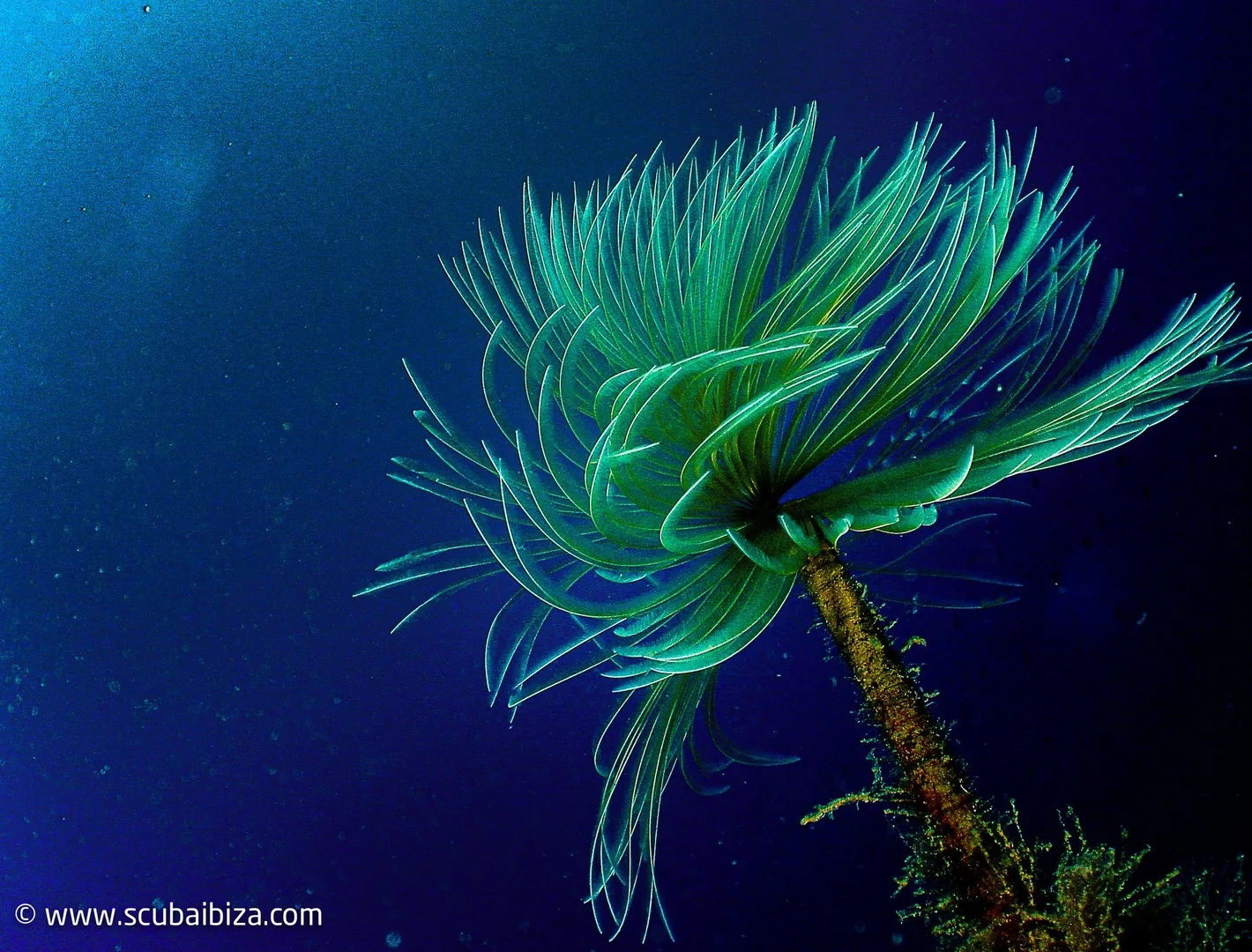
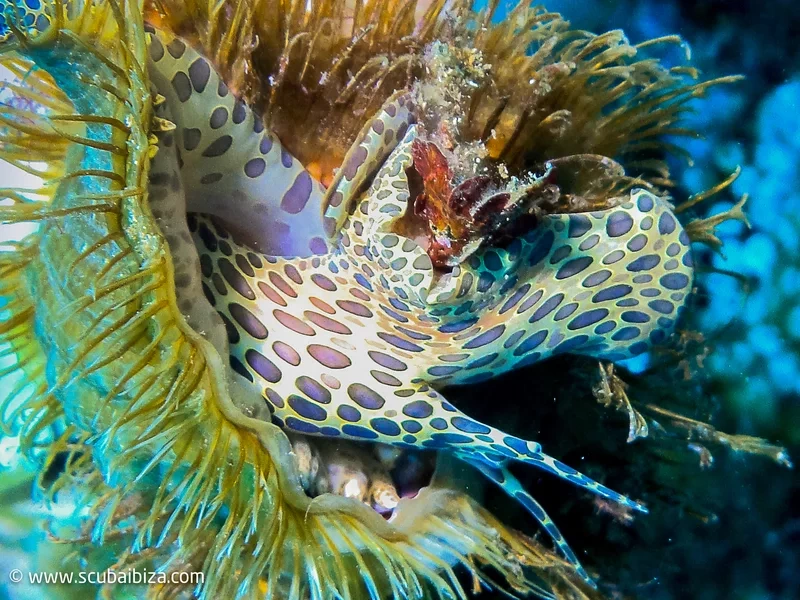
- Marine life: fan worms, anemones, dolphinfish
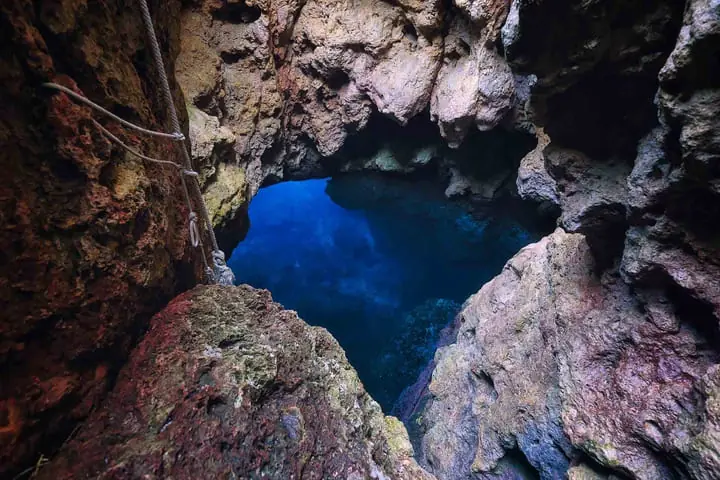
Below the cliffs of the Bay of Aubarca, the “illuminated cave” is a remarkable Ibiza dive site, between the municipalities of Sant Joan de Labritja and Sant Antoni de Portmany. It is reached from the shore and is reserved for experienced divers.
The spot is magical: a spectacular cave a few metres deep. Water flows in naturally through an underground gallery, while the sun’s rays pierce the darkness through openings in the rock, bathing the inside in a golden, mysterious light. An unforgettable underground experience found nowhere else.
Book a guided dive
Below are a few links where you can choose and join scuba diving activities led by professionals in Ibiza.
Diving off San Antonio in the west (Pier of Scuba Diving Boats)
 Ibiza: Sea & Caves Kayaking Tour with Snorkelling From €50 4,8/5
  Until 31 October Ibiza: Snorkelling, Sunset Beach and Cave Boat Trip From €70 4,7/5
  Until 24 October Ibiza: Snorkelling and SUP Paddleboarding, Beach and Cave Tour From €60 4,7/5
  Closed, reopens 1 May 2027 Ibiza: PADI Discover Scuba Diving & Snorkelling Boat Trip From €150 4,6/5
 No activity matches these filters for now.
When is the best time to dive in Ibiza?
The best time to dive in Ibiza is from May to October. During these six months, conditions are exceptional! The water is pleasant and visibility remarkable. The month you choose depends on your priorities: warmth, peace and quiet, or the perfect balance.
I have personally dived in July and October (on the neighbouring island of Formentera) and in Menorca in September. Every dive was superb; for water temperature and crowds, early July and mid-September were perfect!
The clarity of the water is exceptional and particularly impressive around the Posidonia meadows.
Water temperature
| Month | Temperature | Wetsuit |
|---|---|---|
| May | 16–17°C | Thick (5-7 mm) |
| June | 18–21°C | Medium (5-7 mm) |
| July / August | 25–26°C | Thin or shorty |
| September | 23–25°C | Thin to medium |
| October | 19–21°C | Medium (5 mm) |
Summary table
| Aspect | May | June | July / August | September | October |
|---|---|---|---|---|---|
| Visibility | ⭐⭐⭐⭐⭐ | ⭐⭐⭐⭐⭐ | ⭐⭐⭐⭐⭐ | ⭐⭐⭐⭐⭐ | ⭐⭐⭐⭐⭐ |
| Temperature | 16-17°C | 18-21°C | 25-26°C | 23-25°C | 19-21°C |
| Crowds | Low | Medium | Very high | Medium | Medium |
| Price | Low | Closed | High | Closed | Closed |
| Rating | ⭐⭐⭐ | ⭐⭐⭐⭐ | ⭐⭐⭐ | ⭐⭐⭐⭐⭐ | ⭐⭐⭐⭐ |
For the best experience (visibility, warmth, fewer people), choose June, September and early October in Ibiza. You get perfect diving conditions while avoiding the peak summer crowds.
Sources:
- Visuals and site list from PADI (Professional Association of Diving Instructors) https://www.padi.com/
- There are plenty of dive centres: you will easily find one in every seaside town!
For wild swimming, the natural pools of Atlantis (Sa Pedrera) are a spectacular alternative to the classic spots.


