
Have you ever looked at Es Vedrà and thought it was just an ordinary rock? Think again! This mythical Ibiza island hides secrets that will surprise you. Many see it as nothing more than a dot on the map, but it is much more: a giant, unsettling mystery that fuels wild legends.
You have heard about its magnetism, the sirens of the Odyssey, UFOs or the “Triangle of Silence”, but you do not know what to believe? In this article I reveal the wildest legends, the scientific facts and tips for seeing it! Ready to discover this breathtaking mystery?
Key takeaway: Es Vedrà has no magnetic properties (compasses work normally). Its appeal lies elsewhere. At sunset, many visitors report a particular feeling. The rock defines Ibiza’s landscape and draws every traveller’s eye.
Es Vedrà, much more than a rock
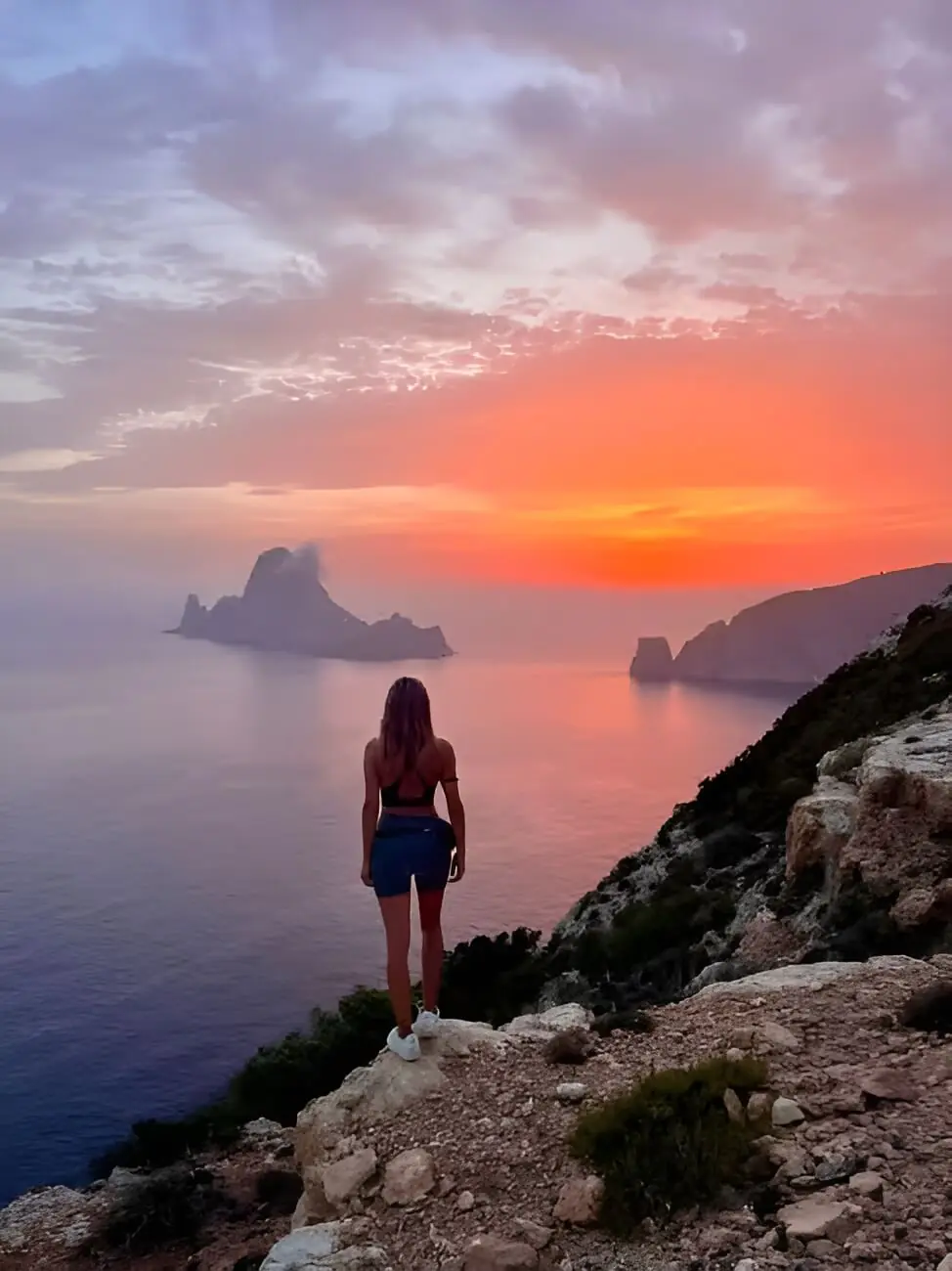
Es Vedrà, a 413-metre limestone giant off Ibiza, has fascinated people for centuries. A protected reserve close to the Ses Salines park, it is home to protected species such as the Ibiza wall lizard and Eleonora’s falcons. Its beauty attracts visitors from all over the world. The rock towers over the Mediterranean. Its ochre cliffs blaze at sunset, and it can even be seen from Formentera. You cannot land on it, but from Cala d’Hort, the nearest beach, the island is captivating. You feel straight away that this is no ordinary rock.
Wild legends are told about it: sirens luring sailors, a giant in a cave, heavenly visions, even lost Atlantis. Some talk of a strange magnetism. Compasses go haywire, they say…
For centuries, Es Vedrà has inspired stories. Every visitor feels something special. Personally, I find it striking!
Ready to find out more?
Es Vedrà fact file
Its geography: where and what?
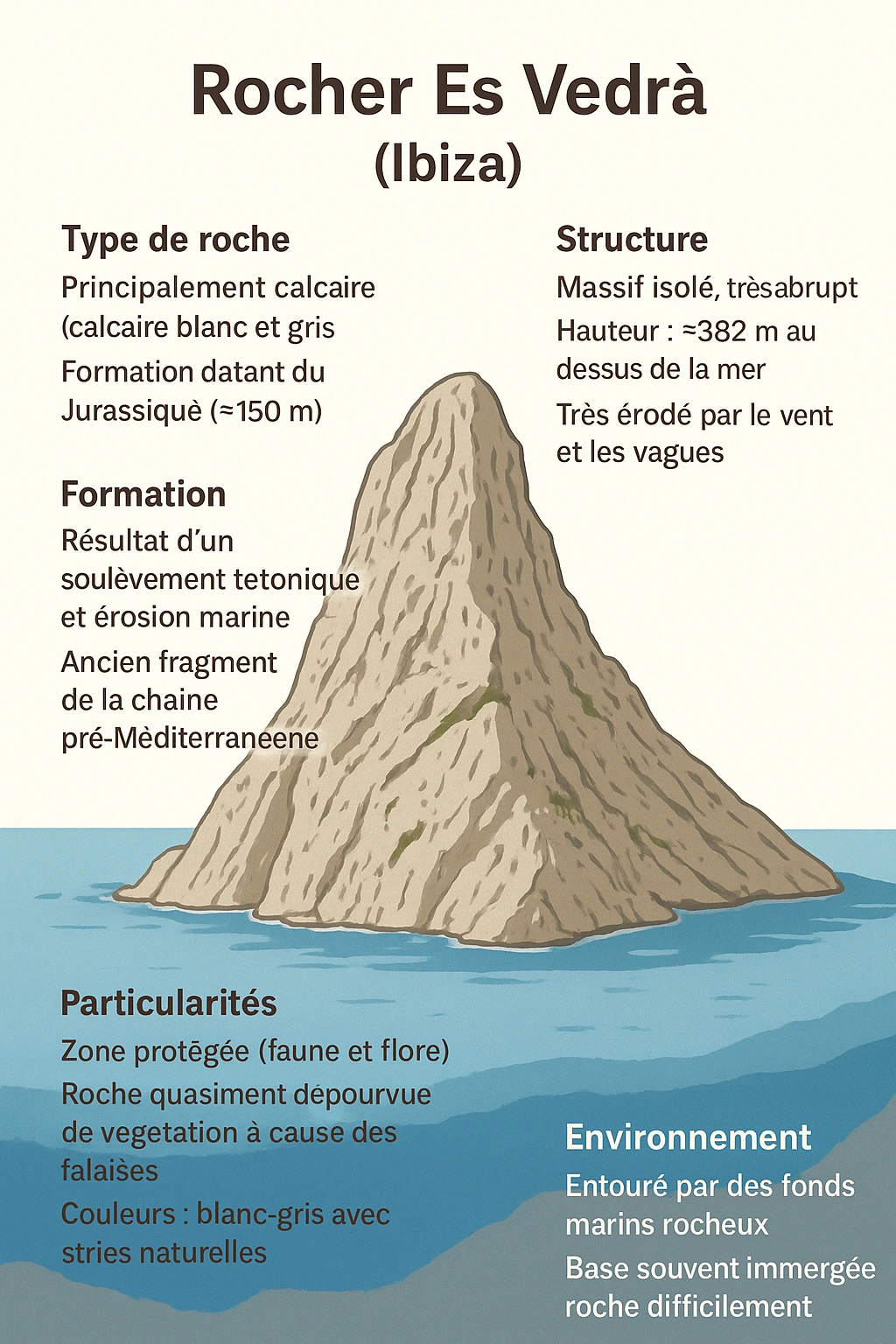
Es Vedrà rises 413 metres above the sea. The rock lies 2.5 km from Cala d’Hort, in the municipality of Sant Josep de sa Talaia (Spanish Balearics). It is made of limestone dating back 155 million years.
Nearby, Es Vedranell completes this rocky landscape.
It was formed by seismic movements that broke up the Betic mountain range, giving birth to the Balearic archipelago.
A strictly protected nature reserve (and a good thing too!)
Since 2002, Es Vedrà has been a nature reserve (source).
Together with Es Vedranell and the Illots de Ponent, it is part of Natura 2000. Classified as a Special Area of Conservation (SAC) and a Special Protection Area (SPA) by the EU, a 2005 law extended the protection to the marine environment. More than 100 protected species live here, such as the peregrine falcon, the Cabrera lizard and migratory birds. The seabed, rich in Posidonia oceanica, is crucial to the ecosystem.
Es Vedrà: no entry!
Landing on it is forbidden!
The island is closed to protect its ecosystem. Some viewpoints, such as Cala d’Hort and Savinar, have also been restricted because of the influx of visitors. Unauthorised events (including a Diplo concert in 2022) and the litter they left behind triggered a local backlash. Faced with inaction from the authorities, residents blocked the private access car parks. Without this regulation, the site would deteriorate rapidly.
The magnetic island that sends compasses haywire: myth or reality?
The legend of the “Triangle of Silence”
Es Vedrà is said to be part of the ‘Triangle of Silence’, with the Peñón de Ifach and a point on Mallorca. Some say it is the second most magnetic point on Earth after the Bermuda Triangle.
Sailors claim their compasses go haywire near the island. Drones lose their way, as if disoriented. But these stories remain unverified anecdotes.
The legend fires the imagination, but there is no scientific evidence.
The mystery of Es Vedrà is above all cultural.
What science says
Scientists have examined Es Vedrà. It is made of limestone, with no magnetic metals. No geomagnetic anomaly has been found. Compasses work normally. The myth lives on, but science is clear: nothing unusual!
Appealing as the legends are, the geological reality is simple.
The energy of Es Vedrà: another kind of magnetism?
Es Vedrà towers over the crystal-clear waters of the Mediterranean. Many people feel a palpable spiritual energy there. Meditation, yoga or simply contemplation: the island offers a deep sense of peace. To take the experience further, our guide to yoga retreats in Ibiza and Formentera lists places and prices.
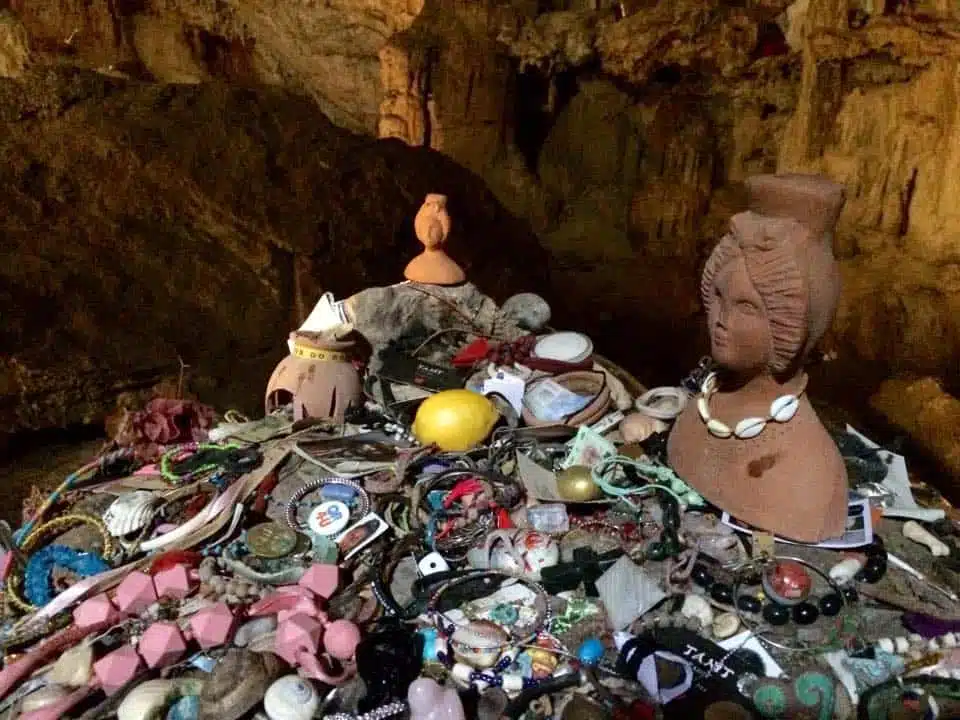
For the ancients, Es Vedrà was the temple of Tanit, the Phoenician goddess. Others see it as lost Atlantis or the lair of the Odyssey’s sirens.
Accounts mention UFOs and mysterious lights. But these are legends, not facts. The island remains a mystery.
Since 2019, the wild goats have been removed to protect the plant life. Es Vedrà is a protected natural area, accessible only with a permit. A treasure to preserve.
Es Vedrà, a land of ancient legends and wild stories
Ulysses’ refuge from the sirens’ song
According to local legend, Es Vedrà was once the home of sirens who tried to lure sailors with their song. Only Ulysses, thanks to his cunning, managed to escape them. The story comes from Greek mythology. In Homer’s Odyssey, the sirens bewitched Ulysses’ sailors, leading them to their death. The rock of Es Vedrà is said to have served as Ulysses’ refuge from that deadly song.
What sets Ulysses apart in this myth is that he did not let himself be seduced. While other sailors threw themselves into the sea, he resisted the creatures’ charms. The legend places this battle of refusal precisely on Es Vedrà, which adds to its mysterious aura.
The story still inspires visitors to Ibiza who come to gaze at Es Vedrà at sunset, in search of magic and ancient mysteries.
The goddess Tanit, protector of Ibiza
The legend of the goddess Tanit and Es Vedrà links this iconic rock to one of the island’s most important deities. Tanit, of Carthaginian and Phoenician origin, is mainly worshipped as the goddess of fertility, the moon, life and death.
Her presence is deeply rooted in Ibiza’s spiritual history, notably through sanctuaries such as Es Culleram and hundreds of figurines found in caves.
At every sunset, one ritual involves drumming in front of Es Vedrà to invoke the magic or positive energy linked to Tanit.
Legend also has it that Tanit can decide the fate of visitors and couples who come to the island, watching over their happiness or putting them to the test.
UFOs and an underwater base: an alien connection?
Several reported sightings describe mysterious lights and UFOs around and under the water in this area, including fishermen who saw lights going in and out of the sea, and lights that seemed to come from beneath the island. Some believe there could be a secret alien base under the island.
A striking incident is the Manises case in 1979, when a commercial airline pilot reported being shadowed by blinding red lights moving at unknown speeds, forcing him to make an emergency landing. These sightings are backed up by accounts from sailors, fishermen and locals describing unexplained light phenomena near Es Vedrà.
The giant and the priest
A popular story tells that the rocky island of Es Vedrà was once inhabited by a giant who lived in its caves and attacked anyone or any ship that came too close. Two brothers had to face this giant to gather samphire, a plant needed to cure their sick father. Thanks to their ingenuity and the help of sea urchins, they managed to weaken the giant and complete their quest.
Meanwhile, the Carmelite priest Francisco Palau took refuge on Es Vedrà in the 19th century in search of spiritual solitude. He is said to have had mystical experiences there, including visions of the Virgin Mary, adding to the sacred and mysterious character of the place.
The best spots to see Es Vedrà
The unmissable classic: Cala d’Hort beach
Cala d’Hort beach offers a stunning view of Es Vedrà. Settle on the sand or on the terrace of one of the 2 nearby restaurants for a paella with a view.
The iconic panorama: Torre des Savinar
Torre des Savinar, built in the 16th century to watch for pirates, used to be the classic 360° viewpoint over Es Vedrà and the Mediterranean. Access to the tower has been closed since February 2025: do not plan your sunset around it. Cala d’Hort beach or a boat trip are the reliable options.
The secret adventure: Sa Pedrera, aka “Atlantis”
Sa Pedrera, “Atlantis”, is an old sandstone quarry with strange shapes. The hippies of the 1960s gave it its nickname. Natural pools, peace symbols, stone circles.
The way down on foot is steep and access by land has become complicated: sturdy shoes and water are essential, and the sea is now the simplest way in (see our Atlantis guide).
| Spot | Level | Best for | Bonus |
|---|---|---|---|
| Cala d’Hort | Easy | Families and relaxing | Swimming and sunset photos |
| Torre des Savinar | Closed | Former viewpoint | Closed since February 2025 |
| Sa Pedrera “Atlantis” | Difficult | Adventurers | Pools and ancient myths |
My tips for planning your visit
The best time: at sunset
Have you ever seen a sunset as magical as at Es Vedrà? Between April and October, the show is breathtaking. Arrive an hour early to find a spot. The sky turns red and purple and the rock glows. A unique, free experience not to be missed: the most beautiful on the island?
By boat or jet ski to see it up close
You cannot land on Es Vedrà, but a boat trip is ideal. From San Antonio, tours go around the island, with a swim in the crystal-clear water near Cala d’Hort.
The trip lasts 4 hours. You will see Port des Torrent, Cala Bassa and other coves. An aperitif is served after the swim. It is the best way to discover Es Vedrà from the sea. No landing is possible, but the view is breathtaking.
So, Es Vedrà: just a rock or a magical island?
Es Vedrà is a rocky island protected since 2002. Its limestone geology is normal, formed 155 million years ago. It rises to 413 metres and stands proudly off the coast of Ibiza. Landing is forbidden to preserve its flora and fauna.
And yet the legends make it mysterious. Many talk of intense magnetism, but scientists have found no real anomaly.
So, Es Vedrà: just a rock or a magical island? It does not matter. Between ordinary geology and dizzying legends, its energy captivates you. The sunset there is breathtaking.
FAQ
What does Es Vedrà mean?
The meaning of the name is debated: a popular reading in Catalan is “it will be seen”, as if the island were made to be admired from the coast. As soon as you arrive in Ibiza, it rises majestically before you, impossible to miss!
How can you see Es Vedrà from Ibiza?
You cannot land on the island: it is forbidden in order to protect it. But don’t worry! Head to Cala d’Hort for a stunning view from the beach. Otherwise, a sunset boat trip is the best way to admire it up close without setting foot on it.
What is Ibiza’s most famous rock?
Es Vedrà, of course! This 413-metre limestone giant is the island’s icon. You will see it everywhere in photos and on postcards… A true living legend that draws every traveller.
What do people say about Es Vedrà?
Some say the island is magnetic, but scientifically that is false. Even so, many people feel a unique energy, especially at sunset. Others love the legends of the sirens and Tanit. In short, everyone finds their own magic there!
Is there a legend about couples in Ibiza?
There is no specific legend for couples, but Es Vedrà is often associated with love and spirituality. Many people come to meditate or enjoy the sunset as a couple. It is an ideal place to make lasting memories!
Which is Ibiza’s most paradise-like beach?
Cala Comte is often described as paradise, but to see Es Vedrà, Cala d’Hort is my favourite.
Want to wake up facing this mythical rock? Several charming boutique hotels in Ibiza have a direct view of Es Vedrà, starting with Petunia, perched above Cala Codolar.
To see Es Vedrà from its best angle, few places match Atlantis (Sa Pedrera), the cove with natural pools a short way from Cala d’Hort.


